
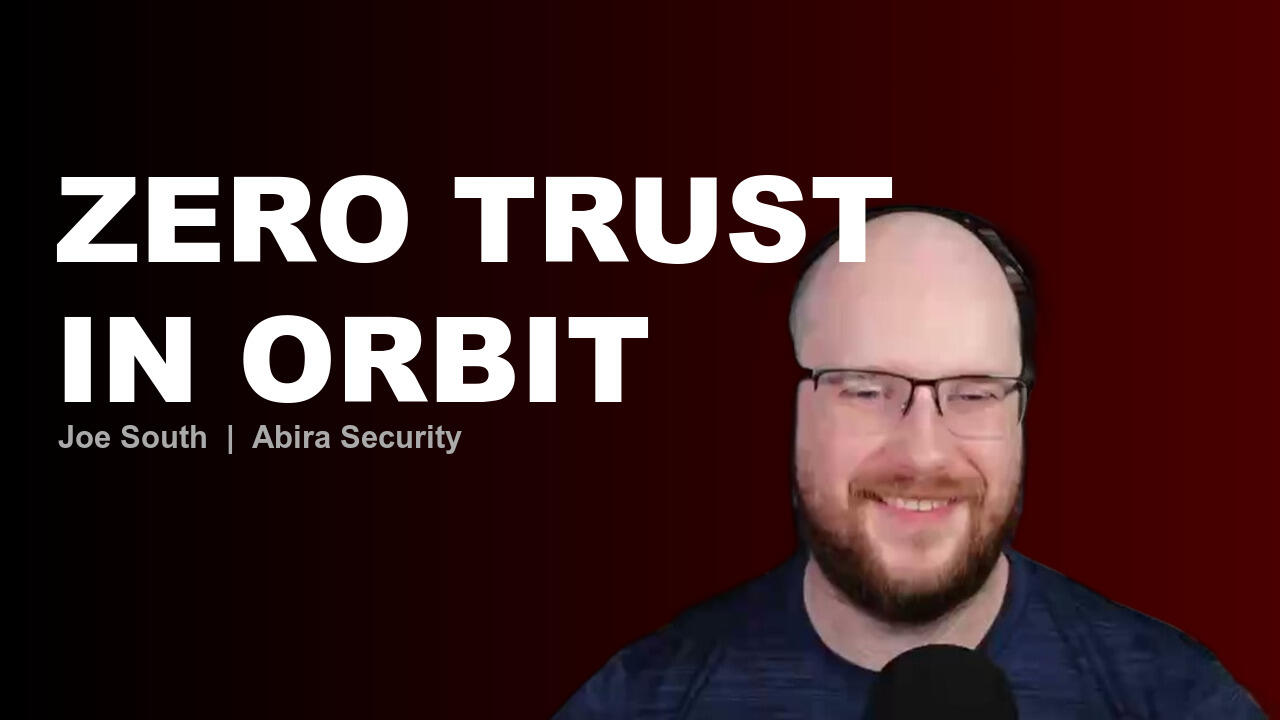
Joe South joins co-hosts Joe Patti and Adam Roth to discuss the state of communication satellite security and the doctoral research he is doing to change it. As Director of Cloud & AI Security at Abira Security and host of the Security Unfiltered podcast (132,000 YouTube subscribers), Joe works enterprise security by day and researches satellite cybersecurity by night.
The conversation covers what satellite security actually looks like in 2026: why the defensive perimeter is almost entirely on the ground, what happens when a satellite’s 10-to-12 year service life collides with a security landscape that shifts every 90 days, and how a zero trust framework could work on hardware that operates on less than three watts of power. Joe walks through his proposed approach, which combines TPM-based component authentication with a distributed trust ring across orbits.
If you work in cloud or infrastructure security and have never thought seriously about space as part of your threat model, Joe’s insights will get you spun up. We also dig into Joe’s personal story about self-sufficiency, the realities of pursuing a doctorate while working full-time, and honest advice for anyone building a podcast around a technical niche.
Guest: Joe South, Director of Cloud & AI Security at Abira Security, host of Security Unfiltered, doctoral candidate (communication satellite security / post-quantum encryption).
Topics Discussed
- Satellite Security vs. Ground Station Vulnerabilities
- CubeSat Lifespan and Patching Challenges in Orbit
- Zero Trust Framework for Low-Power Satellites
- TPM-Based Component Authentication and Distributed Trust Ring
- Hack-a-Sat and the Cost of Testing Satellite Security
- Cyber Warfare, Attribution, and NATO Article 4/5 Implications
- The 2022 Viasat KA-SAT Attack as Case Study
- Pursuing a Doctorate While Working Full-Time in Cybersecurity
- Podcast Growth Advice from Security Unfiltered
Listen Now
📝 Full Episode Transcript ▼
Joe Patti (00:00) Welcome to the Security Cocktail Hour. I’m Joe Patti
Adam Roth (00:02) I’m Adam Roth.
Joe Patti (00:04) Adam, we are truly blessed today because we have not only a kindred spirit in terms of a fellow cyber professional, but we have a fellow podcaster on also, which is awesome.
Adam Roth (00:18) Yeah, he’s been giving us ⁓ some mentoring. Joe, you’re going to pay the check for that one because he’s given us some really good advice.
Joe Patti (00:26) Yeah, we have Joe South. Joe, welcome to the show.
Joe South (00:31) How’s it going guys? Thanks for having me.
Joe Patti (00:34) it’s going great. And thanks. Seriously, we really have been talking to Joe a lot. Do you have, you said what, 100,000 subscribers?
Joe South (00:44) Yeah, I’m at 132,000 subs on YouTube.
Joe Patti (00:48) A hundred and thirty-two thousand
Joe South (00:50) Yeah. Yeah.
Adam Roth (00:51) We’re we’re close, we’re close.
Just so the audience knows moving forward I will be calling Joe South South and Joe Patti Patti because I can’t just say Joe
Joe South (01:04) Yeah, it’ll confuse us.
Joe Patti (01:05) Yeah, that’ll work. And Joe, your show is Security unfiltered, right?
Joe South (01:09) Yep, yeah, Security Unfiltered Podcast
Joe Patti (01:12) And you’ve been doing that for a while at this point, a couple of years, right? Five years? Whoa. You know, we’re coming up on three years. I thought we were like hot and we just hit a subscriber milestone, but you’re just like way past us. Well done.
Joe South (01:15) ⁓ Five years. I think next week is five years. Yeah.
Yeah. Well, it’s a lot of, ⁓
it’s a lot of trial and error and being willing to fail quick and adjust, you know, just as quick. Right. So a lot of trying stuff out. mean, my, my audience that have been with me since the beginning, like, I mean, I had a terrible camera, you know, like my audio and video would cut out all the time. Like it was such a mess, you know, but now I feel like, ⁓
I feel like I have it mostly figured out, you know, for the most part.
when like people meet me or whatever, you know, when I go to DEFCON, they always tell me like, you’re exactly how you are on the podcast. My only response is like, well, I don’t know how to be anyone else. You know, know, so like what you see is what you get. I’m not like putting on some front or whatever, you know, like, I feel like that adds to the uniqueness almost because at least with my podcast, you know, like
I do just about no editing. know, I mean, I should probably put more effort into it, but I still feel like that takes, if I do too much editing, it takes away from the guests, you know, that took their time to come on my podcast, tell their story. And now I’m chopping up their story to fit whatever, you know, agenda I have, right? Like.
Joe Patti (02:49) Well, I think you’re right, Joe, because I did something where usually I do the same thing. I mean, I just cut out the gaps and the coughs and stuff like that. But ⁓ I did one where I said, let me mix it up. I’m like, use an AI. It’s telling me put the exciting things up. Do the hook. Do all this. And I chopped one up and put it up together. And I said, this is good. This is going to really hold the audience. Made no difference whatsoever.
Joe South (02:57) Yeah.
Yeah.
Joe Patti (03:15) So back to your method.
Joe South (03:17) Yeah.
This is something that I’m still trying to figure out for the most part. Where like I’ve done the stuff that AI tells me to do right, and it doesn’t really make a change like at all.
Joe Patti (03:28) you
Yeah,
I’ve kind of noticed that too, so yeah.
Joe South (03:34) Yeah,
the I feel like the longer form podcasts are, you know, they’re kind of like how I consume longer form podcasts. I’ll consume, you know, 30 minutes here, 30 minutes there, you know, like when I can. I feel like most people are probably like that. And then the clips, that’s where you get like higher, higher retention, you know, when you’re posting just like five to 15 minute long clips of that episode.
You know, that’s time stamped and now they’re going to that that longer episode for maybe seeing what what else is there, right?
Joe Patti (04:07) Oh, is that right? you know, I do know and I understand if you do do the clips, and I know we were watching YouTube myself, you see something that’s five minutes, you’re like, okay, I’ll watch this, you get it. But you’re actually getting people from there go on to the full length episode because I’ve tried that with shorts and it didn’t work with shorts. People look at the clip, they’re those shorts, they’re like, yeah, whatever, next one.
Joe South (04:17) Yeah.
Yeah. Yeah, I am seeing it a bit. I mean, it takes a while, you know, like I feel like people have to get used to how you, you know, do content to some extent, right? Like, and then you’re, you’re still figuring it out on your own, you know, I, I’m a real big like stats guy, right? So like, you know, like I look at like other people like, ⁓ like Joe Rogan, for instance, right? I mean, like I’ve been following Joe Rogan since like the very beginning.
You know, in his early UFC days when he didn’t even get paid to do it. ⁓ and he even said, he’s like, you know, I didn’t make any money for like seven, eight, maybe 10 years of doing the podcast. Like he was making like nothing, you know, nothing that like he cared about, you know, which I guess that’s subjective, right? But he literally said in one of his episodes, he’s like, I didn’t even, I didn’t check anything. didn’t like.
Joe Patti (05:01) well.
⁓ that long. ⁓ wow.
Joe South (05:27) Look at them any money or anything like that for probably nine years You know, so for for me to be where i’m at like five years in Like i’m fine with that Jack Rhysider actually told me the same thing from the Darknet Diaries Where he literally said he didn’t even like make money from it for like seven years There’s hundreds of episodes that he’s done that we’ll never see the day of light because like or the light of day, right? ⁓
Joe Patti (05:32) Cheers.
Adam Roth (05:33) It’s… yeah.
Joe South (05:56) I haven’t been drinking yet, so.
Joe Patti (05:58) Well, Joe, you know what? We’re going to introduce you to one of the things we bring to podcasting, which is drinking, of course. So you called it as our esteemed guest. We’re doing whiskey today. Except for Adam, who is too fancy for whiskey. He’s got champagne. I know. pulls that out before recording. I’m like, so you got a bottle of whiskey? He goes, no. Champagne, I know. well.
Adam Roth (06:09) Yeah, yeah, we’re doing whiskey.
Joe South (06:10) Yeah.
What a loser. A champagne.
That’s terrible.
That’s terrible.
Adam Roth (06:25) I’m sorry, I’m-
Joe South (06:25) I hate champagne. I didn’t even have champagne at my wedding. Like they gave it to me and I like spit it out. I was like, what the hell?
Joe Patti (06:29) no?
Adam Roth (06:32) You
Joe Patti (06:32) jeez. Wow. OK. Well, in any case, cheers. Welcome to the show.
Joe South (06:34) Yeah, I hate it.
Adam Roth (06:34) Isn’t
this good? Isn’t this a good brand? ⁓
Joe Patti (06:40) Yes, that’s actually good. I think, wait, or is that another, I don’t know, whatever. Well, this is a good thing I got here.
Joe South (06:41) I don’t know anything about… I don’t know anything.
Yeah, I got Weller 12.
Joe Patti (06:50) I don’t know that one actually. you know, I have so much to learn from you, Joe. It’s crazy. Even when it comes to liquor.
Adam Roth (06:51) pool.
Joe Patti (06:57) All right, so cheers.
Adam Roth (06:58) So, so, South, what do you do for your day job? I think that’s,
I think that’s, I’m curious to that.
Joe South (07:03) Yeah. Yeah. So, my day job, I can actually like say what I do now. ⁓ because the owner like told me he’s like, Hey, you can put it on LinkedIn. ⁓ but for my day job, I’m the Director of Cloud and AI Security at a Abira Security ⁓ a lot of professional services, lot of, you know, VAR reseller sort of stuff. But, you know, I take it from the, approach of like, I was in their shoes.
for 12 years, right? I was on the security engineering and the trenches. I was a security architect, you know, no one was listening to me or anything. So I always approach it from that angle. So when I refer someone to a product or something, like it’s typically like, Hey, I’ve literally deployed this thing. You don’t want that other, maybe more shiny thing. You want this other tool, you know, and it’ll get the job done and you’ll love it.
Joe Patti (07:57) ⁓ so you went over to the dark side. You were one of us. Then you went to a vendor. ⁓ No wonder they want advertising on your podcast. Yeah.
Joe South (08:00) Yeah.
I, you know, I, yeah, I needed…
Adam Roth (08:09) It’s free advertising. Are they a sponsor?
Joe South (08:09) I
wish. Trying to convince them, yeah. Yeah. Yeah. Sponsoring my living, you know?
Joe Patti (08:17) Yeah, they’re sponsoring your mortgage, I guess. I don’t know.
Adam Roth (08:21) You what I find interesting, South? You and I have a crossover where we both are going for a dissertation, am I correct? Yeah, it’s funny, right? It was just sheer coincidence that we both go to the same school. Though I’m not gonna say who it is, but I’ll say the role. I told the dean of the college we were talking about how to get people to do interviews for qualitative study. And I said, hey, know, doctor, what if I go to the UN?
Joe South (08:29) Yeah.
Adam Roth (08:51) sit outside in a van and I black bag the people from that organization in order to get them to do interviews. He goes, I’m gonna recommend that you don’t do that. Because what I’m doing, I’m doing it, I’m doing basically based on NATO. He’s like, no, I would never do that. But the point I was making is you how hard it is to get interviews with people from NATO?
Joe South (08:58) You
Yeah.
Joe Patti (09:05) Hahaha
Joe South (09:16) Yeah Yeah, no, it’s it’s difficult man Like I tell everyone like if I knew how hard a PhD was before going into it. I never would have gone into it You know, but like I have a problem where like I don’t give up very easily So I’m I’m three chapters in out of five, right? ⁓ And my my chair was actually bugging me earlier. He’s like hey send me chapter four. I’m like man. I haven’t even started yet like
Adam Roth (09:29) Yeah.
Joe Patti (09:31) Apparently not, so…
Adam Roth (09:46) I’m not going to embarrass myself and tell you what chapter I’m on, but I’ll tell you this.
I’m like, I gotta talk to Patti. I gotta go, I gotta go. I have to do my homework. I have another three hours to go. It’s just non-stop. And I’m not asking anybody to cry for me. I’m just telling people, be careful if you go for it.
Joe South (10:05) Yeah.
Adam Roth (10:06) I ripped my hair out.
Joe South (10:09) Yeah, it’s challenging, man. It’s really hard. mean, and it doesn’t help that like, you know, you go through all this schooling to get to this point to where like you could even apply to a PhD program. And as soon as you get into the program, everything is completely different from how you were taught for the last 20 years of school. You know, like everything is different.
Adam Roth (10:09) That’s why… Yeah.
Joe South (10:33) my master’s thesis was like, you know 45 pages long or whatever I mean you look at my my dissertation and like chapter one is like 50 pages, you know
Adam Roth (10:45) In fact, he’s supposed to be like under 30, but that’s crazy.
Joe Patti (10:45) Really? Wow.
Joe South (10:46) And I thought it was too
long, you know?
Adam Roth (10:50) It’s funny cuz our school well, I mean I guess we can say it and shout out to it because it’s on our LinkedIn But it’s Capital Tech University and they’re in Maryland and they’re like situated between Washington DC and the school is well known for aviation It’s funny like
When you sit in there, you don’t realize how many three-letter agency people that came out of this school. That’s their claim to fame. CIA, FBI, NSA. What’s that other agency, Joe, that’s not as well known, that people don’t like, that you work for?
Joe South (11:13) yeah.
Joe Patti (11:24) Yeah, that’s the cool one, DIA, okay? Only the cool people know about it.
Joe South (11:26) Yeah, DIA.
Adam Roth (11:26) Yeah.
Joe South (11:28) Well, you know how they ⁓ started the university, right? Well, it was mainly because the NSA and NASA couldn’t find viable talent in the industry. And so they said, well, we have to like literally create a university to teach these people how we want them to be taught because we’re hiring people. And then it takes them two or three years for them to get up to speed on just basic
Adam Roth (11:30) Yeah, Navy Radio Guy.
Joe South (11:55) Stuff in this field and so that’s where cap tech came from and that’s why like a lot of the professors are like Literally from the nsa and the fbi and cia like a lot of those guys are from like I had one forensics professor She was from like Symantec, know, like the team that was in charge of like, you know reverse engineering stuxnet and stuff and All this stuff is like my
Joe Patti (11:57) ⁓
Adam Roth (12:04) Yeah, yeah.
Joe South (12:21) Gosh, like you’ve forgotten more on this topic than I’ll ever know, you know
Adam Roth (12:25) I, by the way,
South I tried recruiting those two guys for this podcast three times from the Symantec Stuxnet movie.
Joe South (12:31) I tried to yeah, they don’t respond Yeah, they don’t respond
Adam Roth (12:33) Yeah, they won’t even answer me.
Joe South (12:36) But I could talk to the CIA guy that may or may not have deployed Stuxnet himself into the network. I could talk to that guy, but I can’t talk to Symantec.
Joe Patti (12:45) ⁓ cool, wow.
Adam Roth (12:46) Yeah, we’re
not that cool.
We’re not that cool, but we have a lot of former 8200 people on and They were working for 8200 during Stuxnet whether or not they did it They’ll never tell us I used to joke with them because we did purple teams with them and I’m like, hey I’m just curious if I wanted to Put malware into a PLC. How would I do that? And they were like Why are you asking us Adam?
Joe South (13:05) Mm-hmm.
Joe Patti (13:14) Yeah.
Adam Roth (13:19) And I’m like, if I wanted to turn on a phone for SIP, if I wanted to listen in on a boardroom meeting in a hotel, how would you do that? They go like, where are you coming up with this stuff? But they knew what I meant.
Joe South (13:33) Yeah.
Joe Patti (13:34) They know.
Joe South (13:34) Yeah. Yeah, they know.
Joe Patti (13:36) Yeah. So Joe, what’s your dissertation? What are you working on?
Joe South (13:43) Yeah, I’m working on deploying the Zero Trust Framework onto communication satellites to prepare them for post-quantum encryption.
Adam Roth (13:49) Or another one.
Joe Patti (13:52) Whoa. Well, that’s very cool. And dude, that’s a lot of buzzwords right there. That’s pretty impressive. You’re going to win in the keyword search there. Yeah, there’s got to be a job for it now. Yeah, like Adam was saying, we’ve talked to people in space. And we did an episode quite a while ago. I think it was with Tom Cross where we talked about satellite hacking and satellite security.
Joe South (13:53) Yeah.
Yeah, it should give me a job somewhere, right?
Yeah, right. That’s my thought, at least.
Adam Roth (14:13) Tom Cruise.
Joe Patti (14:20) That was maybe two years ago. And I remember just being amazed and appalled at the lack of security and how, I don’t want to say backwards, but they were back bordering on telnet stuff. The stuff was so, so basic. Is it still like that? I mean, I guess you’re going to change it when you get your doctorate, but.
Joe South (14:35) Yeah. Yeah.
Adam Roth (14:38) We’re su-
Joe South (14:40) It’s a little…
See, like, this is the problem. It’s a little bit better. But as soon as you launch a satellite into space, it’s immediately, like, outdated. Like, good luck. Good luck patching it, you know?
Joe Patti (14:50) Wow, yeah.
Adam Roth (14:55) We just released an episode with Rene Nguyen, the former CIO of NASA. like Joe Patti’s claimed the fame is putting out, yes, the Mars Rover didn’t have MFA by design. But like, it’s true though, right? You have to be very careful. And then I asked Rene Nguyen, like when you have problems with the wifi on the ISS, how does the help desk get to them to service it?
Joe South (14:59) Mmm.
It’s probably like them. It’s probably the astronauts, you know, up there, literally troubleshooting it.
Adam Roth (15:26) yeah, and then I said-
Joe Patti (15:27) Yeah, they better be good IT
guys.
Adam Roth (15:29) and then I asked her, I said like, do you share the wifi password with the cosmonaut?
Joe South (15:35) Probably have to.
Joe Patti (15:37) Yeah. Yeah, but Joe, so, ⁓ wow, that’s interesting because if you’re talking like, post quantum encryption and stuff, that’s cutting edge. like you say, once it goes up, I guess it’s kind of the ultimate IoT thing that things don’t get patched. mean, what’s the state of the art there? Is ⁓ it going into the newer ones going up? Has it been or?
Joe South (15:56) Yeah.
What do mean like, ⁓ like the, newest, ⁓ security like features and everything.
Joe Patti (16:09) Yeah, like with a new satellite, are they going to have ⁓ something, the post-quantum encryption, are they current, or are they back on SSL 1.0? I mean, what are we talking about?
Joe South (16:21) ⁓
I guess it would depend on what kind of communication you’re actually talking about if you’re talking about satellite to satellite It’s a probably a little bit more secure, you know, like a TLS, you know 1.2 let’s just say at that grade, you know, because there’s proprietary like K bands and all this other stuff that they’re communicating over if You’re if you’re talking about like, you know from earth to the satellite
Joe Patti (16:35) Hmm.
⁓ That’s reasonable. All right.
Joe South (16:50) The security is mostly around the mechanisms that they use to actually get to the satellite rather than the communication itself. So that’s where they base more of it.
Joe Patti (16:58) ⁓ security
through obscurity. Is that what we’re talking about?
Joe South (17:04) Not quite. they are, they’re… Essentially, the satellite will only be allowed to talk to, you know, certain ground stations, right? And the ground station will, you know, typically have a key with it that can talk to the satellite, but then they secure everything, you know, on the ground, right? So they’re securing the systems, they’re securing the person, like they need a cat card to get into the computer to then…
Joe Patti (17:21) does. Okay.
Joe South (17:32) You know authenticate an MFA and being able to allow to identify the satellite and send you know different communications to it and whatnot ⁓ So that’s where they secure it mostly and I actually had my former chair He was a he was a he was an Air Force guy that all that he did with satellites ⁓ for the Air Force and then they broke off in the Space Force and he was doing that and he I mean he literally told me like one of our first calls is like
You know, oh, he was walking me through the process of like the ground stations and whatnot communicating to the satellites and I was like So if I just get something that focuses like my antenna straight at a satellite could I get to it? And he’s like Well, yeah, there’s technically nothing keeping you from it. You have to time it really precisely But you could theoretically do it and I was like, so what’s gonna protect me from like getting into it? He goes nothing like If you want to get into it, you’re gonna get into it
Joe Patti (18:27) ⁓ wow, yeah guess things haven’t changed.
Adam Roth (18:30) No, but wait, wait, wait, wait, wait. So I got sued for what they claim me reverse engineering this encryption for a certain paid satellite service. And the encryption 15, 20 years ago is more sophisticated then for like.
like you know like cable type of satellite than it is for the satellites today is what you’re saying basically.
Joe South (19:00) It’s
probably the same. ⁓ I would call it the same level of security.
Adam Roth (19:06) Look, I don’t know if I have a cool dissertation. I just want to say my dissertation. You tell me whether or it’s cool. Because right now, for the first 10 seconds, it’s right about me. So I’m going read it. Cyber warfare and the implications of not instituting treaties within NATO to promote ethical engagements.
Joe South (19:14) I don’t know if mine’s cool.
Joe Patti (19:29) That’s the title? I thought that was the whole dissertation right there. I don’t know.
Adam Roth (19:30) Yes.
So it’s funny right because we’re almost kind of saying the same thing like south What’s happening now is which like with Renee Wynn we’re talking about satellite ⁓ Satellites in space is kind of dangerous because you know even adversarial countries will position their satellites in between hours in order to cause havoc So there’s no like there’s no control
But the question is, is that ethical? And with what I’m talking about is ⁓ more about cyber warfare. But if one satellite is attacking another satellite near proximity or using targeting to shut down the antennas, is that ethical? Is it going to cause problems? planes, because everything is depending on satellites for GPS.
Joe South (20:26) Yeah, even financial transactions at some point route through a satellite.
Joe Patti (20:27) I would s-
Adam Roth (20:32) People don’t realize how much stuff goes through satellites. Her thing was when they was like, you know, these data apps like Tinder and everything else, you depend on that to find the person near you, you know, but it also depends on crops and water and flying. And so GPS is a major part of almost everything that we do today.
Joe Patti (20:54) So Joe, let me ask you, I mean, talking about these things, when I think of satellites and communication satellites, think I’m too old. I think of those big, huge things that stay up there for 30 years with all these things. But then I hear they got these tiny micro ones too. mean, those little ones, do they have a ⁓ shorter life where they’re going to be replaced more often? I hear some of them are the size of a soda can, or they’re like a shoe box or something.
Joe South (21:06) Yeah.
yeah.
Yeah, I think their expected lifespan is like 10 to 12 years, but they typically last longer. It’s factoring in things like, you know, getting hit by like space debris or whatever, you know, like, ⁓ that’s like the biggest, that’s probably like the biggest problem. But yeah, like the satellites, I thought that the satellites were like as big as my room, you know, when I was like going into it, but no, it’s like a CubeSat satellite is the most common form of satellite.
Adam Roth (21:33) Yeah, it’s a big thing too now with the whole
Joe Patti (21:44) Yeah.
Joe South (21:52) And it’s literally anywhere between like three U’s and 12 U’s of space on a server rack. That’s exactly what it is.
Adam Roth (21:59) So each U is, I think it’s what, 1.75 for those who don’t know inches approximately.
Joe South (22:03) Yeah.
Yeah, something like that.
Joe Patti (22:05) Hmm.
But still, even with 10 to 12 years, mean, from a security standpoint, from a security technology standpoint, that’s an eternity. Think of what we were doing 12 years ago.
Joe South (22:16) Yeah. Well,
Adam Roth (22:17) Look at
that, Joe, like…
Joe South (22:18) yeah, imagine trying to maintain that security, know, like, you know, 10, 12 years ago, MFA wasn’t deployed everywhere. mean, even today, MFA wasn’t deployed everywhere, but like, it’s a lot more deployed. ⁓ so like, that’s why, like, I, you know, I spent a year like looking at basically all of the different attack paths and everything that you could do is essentially
too lengthy of a process, too power hungry, too, you know, processing time hungry on a satellite to secure it, you know, through all the operations that you have to do. So like the only thing at least that I’m aware of, and I’ve confirmed this with quite a few experts in the field that know a lot more than me is to basically authenticate each individual component of the device.
store that on what would be basically a TPM chip and re authenticate it every so often. So like you develop a key for all the components, you verify that key with the TPM chip. If it doesn’t match up, the satellites removed out of out of ⁓ communication with the rest of the ring. And then, you know, future state would be like implementing blockchain, right? So hey, you pass the authentication. Now you get into the blockchain. If you’re not in the blockchain.
you know, then you can’t communicate to a different hierarchy of satellites in one.
Joe Patti (23:44) so the model basically says it’s a mesh network, it’s a distributed system. ⁓ wow, with all of them, okay.
Joe South (23:49) Yeah, it’s a distributed system within the system
Adam Roth (23:49) Well, that’s how it works around the…
Joe South (23:53) and then it’s distributed within the orbit and then it’s distributed within the higher orbit to provide like higher level authentication.
Adam Roth (24:02) And that’s how we understood it, right? Because all the satellites are orbiting and they’re communicating to each other around the planet. And if something gets in that orbit, like another satellite, that’s what causes havoc. But let’s put things in perspective. The Apollo missions, right? They were like 4K or 16K. I don’t even know what it was, but it’s ridiculous. Now you can fit a whole entire Raspberry Pi in a satellite and have more computing power of hundreds of Apollo missions.
Joe Patti (24:02) That’s interesting.
Joe South (24:18) Mm-hmm.
Joe Patti (24:30) Yeah. But Joe, what you said is interesting about the power thing. I know there are power limitations and I just never thought of it. Like, I guess that limits encryption that you can do hashing and stuff like that.
Joe South (24:42) Yeah, I can’t. mean, I know someone listening will like kill me for it, but I can’t remember the exact like number. It’s like less than three watts of operation, like time and performance, you know? So it’s like you have to be, you have to have something where when you do it, it’s not that it’s not that hard on the system and
Joe Patti (24:56) Nothing.
Joe South (25:09) You don’t have to do it very frequently because it needs to be able to communicate very quickly. Right. And so like the, thing that I’m proposing is actually like, if there’s a satellite that, that gets in between, you know, our satellite and another satellite that we’re trying to talk to, like, it doesn’t even matter right now that opposing satellite could like jam and it could, you know, try and intercept the communications and all this other stuff. ⁓
Joe Patti (25:15) Mm-hmm.
Joe South (25:36) With with my method like it’ll literally just basically ask for the authentication if it can’t do it. It’ll be like alright Well, I can’t talk to you. Then I’ll check the other side
Joe Patti (25:46) So it really is a zero trust thing, like you said. A true zero trust. And then are you talking about something there when you have something that fails authentication, then that propagates through the whole network of don’t trust this guy, he’s out. ⁓ and I guess that saves resource too. Very cool.
Joe South (25:47) They’re authenticating themselves, yeah. They authenticate themselves within themselves.
Yep, yep. That’s also a part of like the blockchain part, you know, where it’s like you hit that list,
Adam Roth (26:06) So, yeah.
Joe South (26:08) you know, you’re not talking to anyone else. You can still be up there, but you’re not talking to anyone else.
Adam Roth (26:14) So let me ask you this from redundancy. So if you’re saying this is the Earth and there’s X amount of satellites that are circulating the Earth and it tries to communicate one way, but it can’t because it’s being blocked. It communicates the other way like a SONET It reverses the direction.
Joe South (26:18) Mm-hmm.
It could,
yeah. There’s no reason why it can’t. It’ll just have, you know, antennas on both sides, essentially.
Adam Roth (26:30) More latency.
Joe Patti (26:35) That’s interesting. Gosh. Huh. You know, it’s interesting when hearing some of these things, you know, in these areas that we’re not used to, you know, I start to say, yeah, like that upset. Yeah, that reminds me of SONET Yeah, that reminds me of this old thing. Some of these old things, they’re like, that’s still used somewhere. That’s kind of cool. Yeah, I know.
Adam Roth (26:52) That shows you how old I am. I said SONET right? That makes me like 67 years
old.
Joe Patti (26:57) so.
Joe South (26:58) It’s
interesting. I mean, we’ll see if I can pull it off, you know, I don’t know I feel like it’s gonna go like into a theory area Like I have my theory and it’s like hey I did everything to prove out the theory, but you still got to test it on a real satellite
Joe Patti (27:14) Yeah, how do you do that? mean, is there a way to get time to get stuff?
Joe South (27:16) Yeah,
so you could get time, you have to spend a lot of money. It’s like $10,000 a minute or something is what they charge. Yeah, it’s not cheap. ⁓ Yeah, right.
Joe Patti (27:26) Yeah. Well, you’ve got podcast sponsors. Come on. There you
Adam Roth (27:29) That’s
Joe Patti (27:29) go.
Adam Roth (27:29) right! GoFundMe page to do your dissertation research.
Joe Patti (27:31) That’s right. Do it live.
Joe South (27:32) Right. Yeah.
there, there used to be this one thing that, ⁓ one of the villages at DEFCON put on called like hack a set where they actually launched a satellite in the space and, know, hackers could go and hack it and learn about it and everything like that. But it was so expensive for them to keep it up and running that it no longer runs. And it was actually in one of my documentations, like my ARB or my IRB.
Joe Patti (27:56) Ow.
Joe South (28:00) Saying like i’m gonna test it here and then i’m go to the hack a sat i’ll test it there And like sure enough by the time my irb got approved It was like already no longer a thing. I’m like, my god
Joe Patti (28:12) ⁓ that’s a bummer.
Gosh.
Adam Roth (28:14) So what
type of study is it? Qualitative, quantitative, mixed? my god, so Patti, so you know, there’s two types of studies. There’s qualitative and quantitative. Qualitative is more about interviews. Quantitative is more about stats and numbers. Mixed doesn’t exist unless you’re a crazy. Every professor tells you never do a mixed study. Never do it, it’s like.
Joe South (28:17) It’s mixed.
I’ve been off too much.
Joe Patti (28:25) Okay.
Joe South (28:35) Yeah. Yeah.
Joe Patti (28:35) You
Never do that.
Adam Roth (28:41) I will bitch slap you if you do a mixed study. You have to sell the professor your doctoral person that’s managing you. You have to sell them on a mixed study. You have to beg them.
Joe Patti (28:44) That’s right.
Joe South (28:55) Yeah.
Joe Patti (28:55) Never get
on the freeway it’s suicide.
Joe South (28:59) I wish they would have told me that. didn’t even tell me that. Yeah, it was just…
Adam Roth (29:01) ⁓ they told us that!
Joe Patti (29:06) I
think they told you that after Joe got started with his experience. I don’t know.
Joe South (29:09) Yeah, they’re like hey this idiot’s never gonna finish
don’t do it, you know
Adam Roth (29:15) So Pat, just so you know, the only thing worse than doing, and I say this respectfully to all my colleagues and cohorts, ⁓ the only thing worse than doing a mixed study is becoming a serial PhD, DSE. We have people who have one, two, three, four, five, six, seven doctorates. Yes, because they do it. There’s people who do serial doctorates. He knows this.
Joe Patti (29:39) What? Why?
Adam Roth (29:44) South knows this.
Joe South (29:46) I don’t understand it. They must be like getting them for free or something, you know?
Adam Roth (29:50) because like like two doctorates will probably put you close to 80 to 100 thousand dollars by the time you’re done. So if you’re doing seven of them, the only difference is once you do the second doctorate or third doctorate, and it also depends, PhD versus DSC, a PhD being the standard, like more American, DSC is more European, is a doctor of science, and I have a C for cyber security. if you do.
Joe Patti (29:52) in.
Joe South (30:00) yeah.
Adam Roth (30:19) more than one like you do two or three but you don’t have to repeat all the classes you can just do the research
Joe South (30:25) still a lot of work. It’s a lot.
Joe Patti (30:26) Yeah, and I
mean, if you’re always getting a new one, are you using your existing skills? mean, yeah.
Adam Roth (30:32) That’s the argument.
Joe South (30:32) Yeah, what’s the return on value? You know, that’s
the thing that I always tell people like on my podcast is like, you know, you should be factoring in the return on investment that you do with whatever education path you go down, you know, like you, and I literally did this math, like with my wife, we were dating at the time and she was contemplating getting a master’s. ⁓ and she, you know, is happy that she ended up doing it, but
You have to factor in what the market is like, what the job market is like, right? Like, is this thing always in demand? Is it not? If it’s not in demand, there’s probably no point in getting it. You have to factor in how much you’re going to spend, what the loan’s going to be, what the interest rate will likely be, what the payment will likely be, and how much you’re expected to make when you get it. You know, that’s the only time that like it should be making sense is like when you’re breaking down the numbers and you’re like,
Okay, it offers me this if I go on linkedin how many job postings have that as a requirement, right? Like yeah
Adam Roth (31:37) It’s the opposite. It’s the opposite.
If you have a doctorate, you’re probably going to have an issue getting a job unless you go into academia or government.
Joe South (31:47) Yeah, it offers unique opportunities. I’ll say that. I have a couple unique opportunities that if I wasn’t in the process for a PhD, it wouldn’t even make it to me.
Adam Roth (32:00) South yeah
Joe Patti (32:01) Like
in IT and in technology, because for years I’ve known very few PhDs, very few guys with doctorates in the field.
Joe South (32:05) Yeah.
Yeah.
Yeah, there’s, ⁓ there’s, there’s, there’s one opportunity it’s out of like the UK and I can’t name it or anything or really even give you that many details with it. But I had them on my podcast and literally the last five minutes of the podcast, I said, was getting my PhD and told them what it was in. And he goes, you do understand that there’s like maybe seven other people on the planet with that sort of specialty and
You know, I can’t find any of them and I need one. I was like, ⁓ okay.
Joe Patti (32:41) ⁓ cool.
Adam Roth (32:41) Wow, so you did a job
interview on your podcast.
Joe Patti (32:43) That’s right. You got a job offer on your podcast? That’s cool, Wow.
Joe South (32:46) Yeah, basically.
Adam Roth (32:47) So the only
return on investment so far in my doctorate is I’ve gotten some really good people out of capital tech.
Joe South (32:56) Yeah.
Joe Patti (32:56) You’ve gotten some good podcast guests out of it, but…
Adam Roth (33:00) So I’m looking for Joe, Patti, to help me pay that back for the podcast.
Joe South (33:06) I’m looking for my podcast to pay it back to.
Joe Patti (33:09) Yeah, really? gosh.
Adam Roth (33:11) I mean for
me what I end up being is because I have such a relevant ⁓ dissertation provided I complete it. You know it’ll be like CNN, MSNBC, Fox News. You know I’m joking but like I’m pro- I spoke to Patti about this. I’m probably gonna try to see if I can do some talks. I mean I’ve gone to some conferences recently not specifically about that but you know talking about cyber ethical warfare it’s so-
Joe South (33:23) Mm-hmm.
Adam Roth (33:40) right now between Venezuela and US, Russia and Ukraine and all these other countries that are having and what we haven’t figured out yet, this is my plug for my dissertation, is we talk about radiological, biological, chemical, kinetic attacks and there’s treaties for everything. We talk about Article 4 on how if the sovereignty of a nation’s security is breached, does that rise to that level? And if it does, does it go into NATO Article 5?
Joe South (33:45) Yeah.
Joe Patti (33:52) Yeah.
Adam Roth (34:10) which is an attack on one, attack on all. Fortunately, we have not had, least I know of, an actual cyber war attack. We’ve had cyber attacks, but does it rise to the level of cyber war where a country is gonna go after another country because they got attacked cyber wise? And then it goes back to attribution. So I think it’s relevant.
Joe Patti (34:13) .
Joe South (34:33) I mean we may have seen some of that when Russia invaded Ukraine. Right? It was, but…
Adam Roth (34:38) But it was hybrid. It hybrid.
turning the power off?
Joe South (34:45) Yeah, I mean, well, you know, like obviously Russia, you know, did some pretty big cyber attacks on Ukraine and whatnot. But then as in return, I mean, there was hacker groups all over the world targeting Russian services, you know, all over the place. So it’s like to some extent that’s already happened to and whenever we go into a country, I mean, when we went into Iraq.
Adam Roth (34:52) Absolutely.
Proxies. Proxies.
Joe South (35:13) Right? Like all those years ago when we went into Iraq, if you like read the reports and whatnot, I mean, we turned off the power for months. We turned off the water. Like none of that stuff was coming back on. We literally did it weeks before we invaded.
Adam Roth (35:28) but not once. Yeah.
Joe Patti (35:29) We did. I actually didn’t
know that. thought that was like the, not the first, I think we hit the military stuff first one. I thought they hit the infrastructure later. really?
Adam Roth (35:35) A lot of it’s stealth. It’s stealth until they… yeah.
Joe South (35:35) No, we intercepted all
of their communications for weeks. For weeks we had it all.
Adam Roth (35:43) But my question to you, South, and obviously to Patti, right, is in order for us to consider something a cyber war, one nation has to attack another nation, predominantly based on cyber, and then the other country has to say, you just attacked us. Reconcile attribution. We’re coming after you, and that becomes a cyber war other than a cyber attack. So that’s the thing that I have a hard time differentiating between
cyber attack in cyber war a kinetic war is I’m shooting I’m launching missiles is attribution and we can say the same thing about drones right
You can do so much. not just physical attacks. It’s you can intercept ⁓ data, put Mi-Fi’s, Wi-Fis. You can get signals intelligence. can get, there’s so much you can do, get surveillance. So it’s not just about physical attacks and arming these drones. I’m not talking about military drones. I’m talking about more consumer drones.
Joe Patti (36:49) that brings up an interesting thought, Joe, because in talking about the drones, a lot of them is they deliver a payload. They deliver something for surveillance, for hacking, whatever. ⁓ Is there anything of that going in the satellite world? I I know you talk about some interference and some stuff, but
I mean, are some of the things up there surveillance of other satellites that they’re doing? really? ⁓ OK.
Joe South (37:15) yeah. Yeah. Yeah.
It’s, ⁓ you know, China and Russia have been doing quite a lot of that. I’m sure we’re doing it too. ⁓ you know, but they’ll send up different satellites and try and identify the bands that, you know, other rival satellite nations are, are having and communicating with it and everything.
That’s when they start to try and you know, intercept and not necessarily block. They’re trying to be like a man in the middle, you know, cause it’s, it’s like fairly easy to do it. If there’s a mistake, if you’re not paying attention to like what you’re sending or how you’re authenticating and whatnot, you know, like it’s fairly easy to do it. You just get physically in between two satellites, you know,
Adam Roth (38:03) It’s like having
a hack-five pineapple. You’ll get any deception, you’ll get any data, and then you send it back to the destination. But here’s the irony about all this, too. We talk about satellites, we talk about drones. If you are able to compromise a satellite that has GPS, you’ve in essence compromised the drones. Because the drones are using GPS in order to navigate.
Joe South (38:09) Yeah.
Yeah. Well, I think it’s all going to start like beginning, you know, in, in satellites first, like the next major conflict, it’s all going to start in the satellites, you know, like Russia very shortly after they invaded Ukraine. I think it was like seven days after or something like that. They did their Viasat hack, you know, took down GPS for the region, right? Like had massive consequences.
that weren’t really quite realized, but then everyone was like, wait a minute, this is a big problem. This is like a really big problem. And then I think Russia kind of backed off of it, you know, because I feel like they they probably thought that they were going to get through, you know, Ukraine, like as quickly as possible within a week or two. And then when they realized it was going beyond that, they’re like, well, we can’t we can’t take GPS down for this long of time, you know.
Joe Patti (39:00) Yeah.
Well, do you happen to know? I have no idea. ⁓ Does Russia use the GPS, or do they have their own system, too? Because I know there’s a European system, too, isn’t there?
Joe South (39:28) Hmm, I haven’t looked into it.
Hmm, you know, I’m not entirely sure. I mean, I think that they’re all just based off of the same thing. It might just be different technology that they’re using, you but it’s the same thing at the end of the day.
Joe Patti (39:35) I guess, I don’t know.
Someone put that
in the comments, please.
Joe South (39:49) Yeah, I’m sure someone’s gonna like torch me in the comments like this guy’s getting a PhD and he’s an idiot. You know, he doesn’t know this
Joe Patti (39:51) gonna say no, that’s fine. we’ve said,
Adam Roth (39:52) no.
Joe Patti (39:57) I don’t know about you, but I said I love hate mail. I’ll take anything. We’ll take any engagement.
Adam Roth (40:00) Look, there’s no way
all of us can be experts about every aspect of it, but I’ll tell you this. If somebody has an understanding about European GPS and wants to come on the podcast for satellite and discuss that, yeah, we’ll have them come on too. We can do a whole entire panel. We’ll bring you back on South. We’ll bring on Tom Cross. Well, maybe even Renee Wynn. Joe Paddle will be editing for 16 months.
Joe Patti (40:12) Hell yeah.
and we’ve done, we’ve done boxing. got a, we got a gym. It’s like, Joe, we can, we can face you off in the ring against someone, you know, no problem.
Joe South (40:31) Right. Right.
Adam Roth (40:33) already got
my ass kicked on on a podcast.
Joe South (40:35) I wouldn’t mind the physical gym. I’ve done jujitsu and wrestling, so I’m used to getting choked out and putting on uncomfortable positions.
Adam Roth (40:45) want
to laugh? Go look at a couple of the after hours where I’m boxing against my trainer. He’s about one third my size beating the shit out of me. It’s all good.
Joe Patti (40:46) ⁓ jeez.
Joe South (40:54) Yeah.
Joe Patti (40:55) Well, you’ve got like 30 years on him too. mean, Adam, they do a couple of short rounds. Adam looks like he’s dying. And then Sal, who’s the trainer, he’s a great guy. He’s there like, oh yeah, I think I got to go do this. Just like walks off whatever. Not even sweating.
Adam Roth (41:12) Well,
I’ve lost probably 25 pounds since though too, so.
Joe South (41:18) Oh wow. mean, whatever it takes, you know, we’ve got to, got to watch the weight, unfortunately.
Adam Roth (41:24) I wanna see Patti
go in the rink.
Joe Patti (41:25) Now,
you don’t want to see me go in the ring because I’m not going to get in the ring, I’ve told you, because…
Adam Roth (41:33) Hey, you got hit by the mic. Good. The mic hit you.
Joe South (41:33) Heh. Heh.
Joe Patti (41:34) Yeah, exactly.
I hit myself with the mic, because I’m not in shape for it, and I have no idea what I’m doing. I have too much respect to get into the ring with you.
Adam Roth (41:42) I’m not in shape. I’m not in
shape Joe. I’m fat, but you know like you know, it’s funny I’ll tell you this south like we talk about how to do podcast and stuff I’m like I come up like hey Why don’t we do a podcast on me getting in the ring getting my ass kicked? He’s like no He’s like, you know what? Let’s do it Adam. Like I come up with these crazy ideas
Joe Patti (42:02) Well,
you want to stop over it. Joe, like, you know, I’ll tell you, we started out with audio. know. Did you start out with audio? Did you always do video? Yeah. Okay. So we start out with, we start out with audio. Then after maybe six or seven episodes, we’re like, okay, we’ll switch the video. And, know, it’s not that simple. got all these things to deal with. So like we switched the video. We do like one video episode and Adam goes, yeah, you know, let’s, let’s go to my gym. Let’s get with.
Joe South (42:11) Yeah, yeah, started with audio.
Joe Patti (42:30) Sal or Boxum would do all this stuff. And I go, Adam, we just went from audio only, like, you know, in our little home offices, whatever. And now you want to do like like a four camera location
Adam Roth (42:41) But
Joe Patti (42:42) All right. Well, Joe, I’ll tell you, boy, time flies when we’re having a good discussion. This is crazy. Yeah.
Adam Roth (42:46) Yeah, I feel like we just started two minutes ago. Yeah.
Joe South (42:50) Yeah, no, was a fantastic conversation so far, for sure.
Adam Roth (42:56) So, you know, I feel like both Patti and I need a little bit of advice and coaching here. Like, what should we do to like, you know, get closer to where you are?
Joe South (43:08) Yeah, I mean, that’s a interesting question. I would say.
You know, you’re doing the right things for sure. And I would just always like look for ways, you know, to improve, right? Like one year I improved my lighting and this year I improved my camera. Like got a new, you know, 4K camera, right?
Joe Patti (43:31) Yeah, that’s really subtle, Adam. Fighting in camera. That’d be good. Yeah.
Joe South (43:35) Yeah.
Adam Roth (43:35) What? Next year I’m… Okay, I’ll tell you… So,
Joe South (43:38) Those
are big ones.
Adam Roth (43:39) so yeah, yeah. Next year I’m improving my attitude.
Joe South (43:42) That sounds more far-fetched than you improving your lighting or camera.
Joe Patti (43:45) Yeah,
really, we’ll do better with the technology.
Joe South (43:47) Yeah.
Adam Roth (43:48) Like, you know, this is a thing that Patti and I ⁓ have realized.
If you keep at it and you’re persistent, you will grow. But it’s going to be like small spurts and then a large spurt. Small spurts and a large spurt.
Joe South (44:07) Yeah. No, that’s very true. You know, like, and I tell everyone, you know, even with my podcast, right? Like I’m very persistent. Like, you know, every year this past year was the first year that I didn’t like sit down and say, am I going to continue doing my podcast? Like every other year I’ve asked myself that question, but I’m very persistent. You know, like I believe I fully believe you keep on knocking.
they’re going to answer the door eventually and they’re either going to say yes or no. And if it’s no, you go to the next door, you know, like just plain and simple, like I’ll, I’ll send people emails and I feel so bad. And I like tell them in the email, if you tell me yes or no, the emails stop, right? Like it stops. Just give me an answer. And some people get it and some people don’t, you know, and I don’t get it. I guess I’m very hard headed, right? But like,
If I email you, if I message you, like I kind of expect a response, you know, of some sort.
Adam Roth (45:10) Yeah.
Joe Patti (45:10) Well, you sound just
like Adam because he says exactly the same thing. You gotta keep at it. And ⁓ for us keeping at it, I do this because I wanna give back, but also we enjoy it, obviously.
Adam Roth (45:24) Look, at the end of the day, Patti and I have come to a point where we’ve realized that a lot of things are tied together. And we have a consulting company that we’re looking, hopefully, to grow. if I told you it was all about giving back, I’d be lying. It’s also about
making money but not making money where I want to buy a Porsche or a Corvette or like or or 20 million dollar house I don’t care about that I really don’t what I do care about is being self-sufficient with a salary that allows me to do what I really enjoy and that’s where Joe Patti and I are aligned we believe that we have a lot to offer it’s just gonna take some time so as we but we’ve never wanted to quit Joe or Patti right
Joe Patti (46:15) Well, the only thing better than doing something that you really enjoy is doing something you really enjoy and making a living off it, making some money off it. That’s cool.
Adam Roth (46:21) and and make it living. what, that’s what I’m getting at. That’s exactly the point.
Joe South (46:23) Yeah.
Adam Roth (46:25) You know.
Joe South (46:26) Yeah.
Yeah. I definitely enjoy security overall, you know? ⁓ But like you said, like it’s something totally different when you’re able to be like fully self-sufficient. You’re no longer beholden to, you know, some company to pay your mortgage. ⁓ You know, like I, I, I was in high school when oh eight hit, right? And my dad lost his job overnight. He was at the company for like 20 years, lost his lost his job overnight.
You know, we almost lost the house. Like there was times when there wasn’t food in the pantry or food in the groceries, you know, like, and I got a younger brother and a younger sister, you know? And so like I learned very young. It’s like, okay. If I want to have clothes for school this year, I need to go get a job. If I want to eat, I need to go over to a friend’s house or I need to go like find some food, you know, like that’s what it was for me. And so now ever since then, especially now that I have kids,
You know, it’s like, okay, well, like I can’t rely on my day job. Like, I’m sorry. I know you say that you’re very stable, but at the end of the day, I’m a number to you. You know, I’m just a number. I’m an expense. Right. And when you determine that you can no longer pay for that expense, you know, that expense is gone. It’s plain and simple.
Joe Patti (47:38) video.
You know,
you know, Joe, you’ve told us a lot of things and helped us out and that may be the best advice of all for everyone. ⁓ you know, you gotta, you gotta make it, find a way to make it happen yourself or at the very least don’t count on some company or whatever being there for you. They won’t be.
Adam Roth (48:05) And it’s not a knock against any company I’ve ever worked for, but at the end of the day, there’s nobody else who’s going to be an advocate for yourself except for yourself. it’s not like, you look, it might not be personal, like, let’s get rid of this division. Let’s get rid of this department. Let’s get rid of this customer. And if they have to shed it, they have to shed it. Most of these companies are publicly traded and they have to do what they have to do to return it to the stockholder. It’s not personal.
Joe South (48:34) The company’s number one goal is to survive at all costs. It doesn’t matter if there’s one person left working at the company and they have, you know, the same customer base and they have to refinance their debt and fricking, you know, hire some people on to do the actual work and whatnot. Like it doesn’t matter. Their only purpose is to still remain in business. That’s it.
Joe Patti (48:34) Well, it’s not
Yeah, that’s it. And it’s a reality. I yeah, it’s not personal, but at the same time, a kick in the nuts is still a kick in the nuts, whether it’s personal or not.
Joe South (49:01) Yeah. It’s personal when you can’t pay your mortgage. Yeah,
it’s not personal for them, but it’s personal when you can’t pay your mortgage. You know, when you’re supposed to provide for these little kids, it’s like, okay, you know.
Adam Roth (49:11) You know.
Joe Patti (49:12) Yeah, that’s right. ⁓
Adam Roth (49:16) We can agree, we’re all on LinkedIn and we all have a decent amount of followers. And we see nonstop in our feeds, people like, I don’t know what to do anymore. I’ve been waiting for months and years. And it’s so horrible because these are the people that really want a job. And I find myself reposting four or five, six times a day. I don’t think anybody’s ever benefited from me reposting. I’m gonna do it. And I’m gonna be…
Joe South (49:27) Yeah.
Yeah.
Adam Roth (49:46) a little bit transparent, not that I’m like a godsend. I’ve seen people asking for money, ⁓ a GoFundMe or something, and I’ve sent not a lot of money, but I’ve done it. And I feel like a sucker sometimes because I never want to give money on a New York City subway. But I feel like a lot of these people that are doing it are sincere. You look at their work history, assuming it’s real, I feel bad for them. I feel very lucky.
Joe Patti (49:53) Yeah.
Adam Roth (50:16) I have a job, my company pays me, I do the work, they pay me, and a lot of people just want to work.
Joe South (50:24) Yeah. Yeah. That, I mean this, even this week, you know, a lot of people have asked me like, you know, how do you like your job and how do you like your company and all that stuff? And I’m like, Hey man, I’m employed. Like I see LinkedIn, like I see what’s going on out there. I’m employed. I have no complaints. You know, like I like the work that I’m doing. I like the company. I like the people I have. I have no complaints, you know, cause I get to pay my mortgage at the end of the day.
You know, like it’s like, sounds like such an old, I feel like I’m so old when I say that, right? But like, it’s true. You know, like there’s a certain level of responsibility that you have, whether you want to admit it or not, when you have kids.
Joe Patti (50:55) All right.
⁓ yeah, you know, it’s funny, had a…
Joe South (51:12) It’d be different if I was
single in an apartment, you know, it’s like,
Joe Patti (51:16) No, but
still, at the same time, I had an interview once. And I’m not big on the corporate speak and all that. But I interviewed with a guy once. And I go to this brutal interview. was tough, whatever. And he goes, why do you want to work here? And he’s like, why do you want to work here? What does this do for you? And I honestly said to the guy, I said, it’s a job, right? You pay, don’t you?
You know, it’s like, what the hell else are you looking for? know, they don’t like, I was lucky that he appreciated that. But at the end of the day, you know, when you wipe all that stuff away, it’s, it’s job. You got to make a living, you know?
Adam Roth (51:44) They don’t like to hear that. They don’t like to hear that.
Joe South (51:44) Right? But it’s not that complex.
Adam Roth (51:55) I’ve never woke up
and said, hey, I want to go work at this organization. This is my dream job. It’s not the take away from any company I’ve ever worked for. I enjoy what I do. I’m passionate about what I do. There’s a certain level of integrity of what I have to deliver. But at end of the day, you know, like when someone says, why do you want to work here? It’s almost like saying, well, would you work for free if I gave you the job?
Joe South (52:19) Right. Right. Yeah. No, it’s I’ve had that too, where someone asked me like, well, why do you want to work here? It’s like, what do you mean? Are you are you paying more? You know, like that’s what it is.
Joe Patti (52:19) Yeah.
Yeah, exactly.
Uh,
you know, we’re at the end of the show and I’m at the end of my drink. So, you know, I’m willing to say it’s like, when they ask you that, why do you want to work here? It’s almost like, okay, now’s your chance to kiss my ass. All right. You know, do your best, you know.
Adam Roth (52:45) Well, that’s funny you say that, I was just gonna say, I
was gonna say like, why do I wanna work here? Why do you feel like you’re interviewing me? Like, I’m really good, I know what to do.
Joe South (52:57) Right, you can flip it around
too. It’s like, well, why do you want to hire me?
Adam Roth (53:00) Yeah.
Joe Patti (53:01) Yeah. All right. Well, Joe, thanks so much for joining. We’ve had a lot of fun and we’ve learned a lot, which is always a good episode.
Adam Roth (53:10) feel like this has only been 10 minutes of recording.
Joe Patti (53:12) Yeah, I know, it’s sped by.
Joe South (53:12) Yeah, yeah.
Well, thanks guys. I really appreciate you having me on. I’m sorry it took it took way too long to get this together, you know, but ⁓ yeah.
Adam Roth (53:20) It was 100 % worth the wait. was 100
Joe Patti (53:22) Life is life. These things happen.
Adam Roth (53:24) % worth the wait, yeah.
Joe Patti (53:24) And everyone, don’t forget, join one of Joe’s many, more subscribers than we are and check out Security Unfiltered. It’s a great podcast.
Adam Roth (53:35) And if you have time after that, check out Security Cocktail Hour.
Joe Patti (53:38) That’s right. You can watch us too. You can watch
Joe South (53:39) Yeah.
Joe Patti (53:40) a few more of ours. Okay. Thanks again, Joe.
Joe South (53:43) Awesome. Yeah. Thanks.
Adam Roth (53:43) Thank you guys.
Joe Patti (53:46) All right. Thanks for listening, everyone. Take care.
