
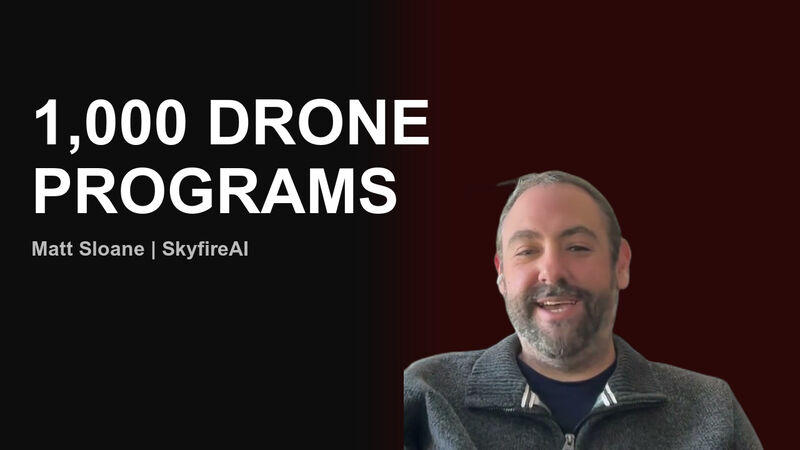
Matt Sloane has spent 13 years building drone programs for over 1,000 public safety agencies. As Co-Founder and Chief Strategy Officer of SkyfireAI, he’s at the center of three converging forces reshaping how drones are used in the United States: the rapid expansion of drone first response (DFR) programs, the federal government’s nearly billion-dollar investment in counter-UAS ahead of the 2026 FIFA World Cup, and the FCC’s sweeping ban on new foreign-made drones.
In this episode, Matt explains how drones in public safety went from “that’s a toy” to “negligent without one,” walks through how counter-UAS mitigation actually works (including some memorable stories from the Super Bowl), discusses the shift from FAA Part 107 to the autonomy-first Part 108 framework, and shares what he told the White House about the Chinese drone ban and its impact on American public safety.
Matt Sloane is Co-Founder and Chief Strategy Officer of SkyfireAI. He previously founded Skyfire Consulting in 2014 and has worked with agencies ranging from local police departments to three-letter federal agencies.
What We Cover
- How drone first response (DFR) programs are transforming 911 operations
- The FAA’s Part 108 framework and the shift to autonomy-first drone operations
- From “that’s a toy” to essential equipment: 13 years of public safety adoption
- Multi-ship formations and the “S-word” (swarm)
- What was really flying over New Jersey in 2024
- Remote ID and 57 drone incursions during Super Bowl LVIII
- How counter-UAS authority is shifting from the FBI to state and local agencies
- The Gatorade bottle, the sniper, and the bus full of nuns
- Why shooting down a drone is legally the same as shooting down a 747
- Indoor tactical drones for building clearing operations
- Next-gen sensors: optical gas imaging, ground penetrating radar, RF detection
- FPV drones and what Ukraine has taught every military on the planet
- The Pennsylvania substation drone attack as terrorism
- The Chinese drone ban: what Matt told the White House
- Supply chain risk: could China remotely disable 90% of American public safety drones?
Listen Now
📝 Full Episode Transcript ▼
Joe Patti (00:00) Welcome to the Security Cocktail Hour. I’m Joe Patti
Adam Roth (00:02) I’m Adam Roth.
Joe Patti (00:04) Adam, today we’re back to your favorite subject, drones. And we have an Uber expert, Matt Sloane. Matt, welcome to the show.
Matt Sloane (00:12) Thank you for having me, guys. Good to see you.
Joe Patti (00:14) you’re one of those people who hasn’t just gotten into it. I got into it, a couple of days ago, I finally bought a drone. So I’m like, I got to see how these things actually work. And I immediately crashed it into a tree. ⁓ but I do need some training.
Adam Roth (00:20) I’m
Matt Sloane (00:21) Welcome.
Sounds like you need some good training, I know a guy.
Joe Patti (00:30) Matt, you are significantly more experienced in this than I am, or even Adam, as a matter of fact.
Adam Roth (00:35) Absolutely, yeah.
Matt Sloane (00:36) Yeah, yeah. I’ve been doing it for 13 years now. I’ve been in the drone industry. it’s been, it’s been an interesting ride, but I’ll tell you that when we first got started doing this back in 2014, we were like duct taping GoPros to these things because the cameras were so bad. So we’ve, we’ve come a long way in that short period of time, for sure.
Joe Patti (00:54) Well, I think the cameras have gotten better and cheaper too.
Matt Sloane (00:57) yeah, no, absolutely. We, I’ll never forget. I was, ⁓ you know, we, we do a lot of work with public safety and primarily work with public safety. And this was, I don’t know, probably 10 years ago. I said, we really need a thermal camera on these things. And I sat in a room, ⁓ with a product engineer from DJI I said, look, I really think we need to put a thermal camera on these things.
And he was like, you know, how many do think we can sell? You think we can sell 10,000 of them? I was like, I mean, not me personally, but yeah, I think people will buy them. Now it’s like, if you have a drone without a thermal camera on it, it’s like a, it’s like a crime against humanity.
Adam Roth (01:28) what people not realizing that you know Back in the day drones really flew during the day not at night and now drones are actually I’m not saying they’re not a not they’re not a day thing They’re definitely a day thing, but they definitely enhance night, especially if they can’t get if they don’t have a helicopter or aviation program It goes without saying having a thermal program, but you’re not you’re speaking to a guy that sat there and said Maybe I want to
I was finding the cables that were USB-C, the HDMI that were made for a certain vendor that I can plug in and do RTMP to RTSP on my NVR, my network video recorder, because I wanted to ingest it without having to pay for licensing for software to track. you know, it really depends on what you want to do, but you can get some enhancements anyway. And especially like a company like Skyfire AI, I’m sure you find ways of detecting things. People are looking for smoke detection.
They’re looking for fire detection. They’re looking for gunfire. They’re looking for aliens from another planet, possibly Mars.
Joe Patti (02:29) *You
Matt Sloane (02:31)* Yeah, that one we haven’t had. We haven’t found the right detector for that one yet, but we’re still working on it, but it’s coming. Yeah. Well, I mean, once these UFO files get opened up, we’ll know exactly what we’re looking for. yeah, I mean, look, I think, you know, the obvious, you know, the daylight camera, obviously you need, right? I mean, that’s the whole purpose of having a drone. ⁓ The thermal camera, very important. And then, you know, there’s lots of other stuff coming out now too, ⁓ I would consider not just cameras, but just
Adam Roth (02:34) Soon. Soon.
Joe Patti (02:36) *you
Matt Sloane (02:58)* different types of sensors. it could be, know, new chem bio detection, know, gas detection, ⁓ magnetometers. So, you know, there’s a couple of projects that we’ve been sort of on the periphery of, you know, they’re looking for old, you know, gas lines and things like that. So you can actually detect metal in the ground. There’s ground penetrating radar. There’s, you know, RF detection payload. So like if you’re looking for a lost hiker and you need to go look for a cell phone ping or whatever, I mean, there’s all kinds of crazy stuff out there now. Of course.
Every time you add a sensor, you’re adding a major pucker factor to the flying experience and about $50,000 to the bill if you crash the thing. it’s pretty amazing what you can do with the drone. We tell people too, the drone’s like a tractor, right? It’s only as good as whatever you put on it. That’s the part everybody likes to talk about is, what drone did you get? But drone’s really not that important. As long as it flies, that’s the key factor. ⁓
Joe Patti (03:53) So I got to say then it’s like an AI agent. need tools because now we can use the AI hashtag. So we’re good. Okay. Go ahead. I got the AI plugin.
Adam Roth (03:58) Well, it’s on the edge. Yeah. Yeah, that’s exactly it. Right. It
has to be on the, it has to be on the edge to really have the level of processing. Everyone talks about like, yeah, we could add AI and I’m not saying you can’t, you know, from the cloud, but you know, when the cloud is great too, everyone’s doing that. But if you can edit somehow or another communicating from the edge to the cloud and having both, that’s really the way to go.
Matt Sloane (04:03) *Yeah
Adam Roth (04:24)* The question I have for you, Matt, is when is the sensor coming out for a wireless access point? Because that’s the good rogue detection, the purple teaming, red teaming. I mean, that’s really cool. We had a podcaster, a person, a guest that came on about a couple episodes ago, and he was talking about when we, in New York City, there was a DJI Mavic sitting out somebody’s office space, and they had the access point.
And I know that you can use the access point to do a man in the middle attack with an LTE, sending that signal back into the LTE cloud internet. So it’s really cool how you can do command and control. Amazing things.
Matt Sloane (05:01) Yeah.
Well, and it’s amazing how you’re seeing things move, right? Because originally, you know, everything was point to point, right? So you would stand there with a remote and then the drone would fly as far as you could fly it until you lost signal or until you reached the end of line of sight, if we’re being legal about it. ⁓
Adam Roth (05:18) Yeah, I was just gonna say that, yeah. have
Joe Patti (05:18) *You
Adam Roth (05:20)* to mean, disclaimer, you must maintain under FAA part 107 visual line of sight. Yes.
Matt Sloane (05:25) Yes. Yes. Unless you get a waiver, which we’ve done plenty of, but yeah,
for now. So it’s point to point, and that’s a wireless signal, no problem. It’s 2.4 or 5.8 gigahertz. But when we start to get into real thing, like real line, beyond line of sight where we’re doing things like long range package delivery, ⁓ power line inspection, if we’re starting to fly.
organs across town from one hospital to another hospital, you those things, you need more than just a point to point wireless connection. So we see a lot of ⁓ drone companies now are using LTE. And so we have the ability to kind of control that drone independently ⁓ of the base station. And, you know, there’s ⁓ a new drone that just got released last week that’s got Starlink built into it. So, you know, there’s all kinds of really exciting stuff happening. And, you know, I think what, you know, what we’ve seen the evolution is
Adam Roth (06:11) Yeah, yeah.
Matt Sloane (06:18) you know, that, you know, the graphic where, you know, got the hunched over, you know, ape, and then they start to, you know, get taller and taller as you kind of that. That’s where we’re at right now in the drone industry is, you know, we started with the guy standing here with a remote and then now we, you know, we’re moving to, um, uh, to the LTE and then to the satellite connectivity, you know, eventually, uh, you know, well, we have, you know, ability now to even just put, here’s a flight plan, send the drone out. goes and does the flight plan and comes back and you’re not giving it any control signals. So.
I mean, there’s all kinds of cool stuff coming. Obviously, you know, the military folks have had some of this stuff for, you know, probably two decades before we even get our hands on it.
Adam Roth (06:53) And then we also had another gentleman, Che Bolden, that’s coming out in the episode. He was, from my understanding, one of the people that brought military drones into the military. And that’s what we talk about, right? Autonomous drones, like commercial drones are now becoming more autonomous. I’m not saying they’re not autonomous now. Even with the FAA 107 waiver, you can go beyond visual line of sight, but it still requires
Matt Sloane (07:05) Mm-hmm.
Adam Roth (07:20) somebody attending to it, though there also was something new, where you can manage multiple drones with one pilot, which just came out recently. And there’s nothing wrong with that, because if you look at Waymo’s and there’s other vehicles, ⁓ that whole goal is to control autonomous vehicles ⁓ more than one without having to worry about it. So if you’re having people on the ground with autonomous vehicles,
Matt Sloane (07:27) Mm-hmm.
Adam Roth (07:44) I think it’s safe to say we can figure out how to do it in the sky as well, though eventually you’re to look up and you’re to say, wow, there’s a thousand drones up there. I’m getting my Amazon package. I’m getting my lunch. I’m getting my fries, you know.
Joe Patti (07:53) *You
Matt Sloane (07:57)* Well, you guys wouldn’t know anything about that in New Jersey, right? I have heard that there’s nothing, no mysterious drones flying around in the skies over New Jersey.
Joe Patti (08:05) Oh, yeah, please.
you know, it’s funny though, because I am, like I said, I just got a drone and Adam’s teaching me all this stuff. So I’m like, oh, let me look up the rules, see if you can do it. Tell me there are all these restrictions, you got to be careful. And like everything else, everything’s illegal in New Jersey. You know, no parks in my county, can’t do it, all this stuff. So I guess I’m in my backyard, maybe I’ll annoy the neighbors. But Matt, so when you talk about autonomous stuff, I mean, there are many different levels of autonomy, you know, including in cars, but I suppose with
Matt Sloane (08:25) Yeah.
Adam Roth (08:27) Yeah.
Joe Patti (08:35) drones too. what are the levels? What’s legal? mean, do we, are we at the point where it’s supervised, where you’re truly giving this thing a flight plan and just letting it go? Where are we these days?
Matt Sloane (08:46) Yeah.
Yeah. So it’s interesting because it’s not really a technology problem. It’s more of a regulatory issue right now. so, you know, under part 107, which is the rules that we all fly under, public safety has a different framework, but even under that, under that framework, ⁓ the, is a mandate to have a pilot flying the aircraft, right? So there is no autonomy. is semi autonomy. So I can say, Hey, go fly to this address, hit go.
I’m still responsible for what the drone’s doing. I still have a controller in my hand. I might be standing outside or I might be inside with a PlayStation controller in my hand doing it. But the point is I’m still in control of that aircraft. And that’s what the law requires under part 107. Part 108, which is in the works right now, they, without boring you to death with FAA rulemaking, they put out a proposed rule last year. We all commented on it. Now they’re going to come out with a final rule later this year. Part 108 actually
prefers autonomy over human operator. And so ⁓ it says autonomy first with a human overseeing the system. And the reason that that is, is because we’re trying to allow for things like package delivery and medical device delivery and air taxis and all that good stuff. And so, you know, at the end of the day, as much as we hate to admit it, ⁓ you know, the, the autonomy is probably going to be better at flying the drone than we are. ⁓ And so, you know, we obviously still need the ability to
oversee and intercede if we need to. ⁓ Adam, you talked about the one to many waivers that are coming out now. ⁓ can’t physically, the mental task saturation is too high for you to manually fly more than one drone at a time. And so we need increasing levels of autonomy to be able to handle that. You think about when we first started in the public safety space, there was five or 10 agencies that were doing it.
Joe Patti (10:25) Sorry.
Matt Sloane (10:37) And, we’d go into an agency and we’d say, Hey, check out this drone thing. And they’d be like, that’s a toy. I don’t need it. You know? And then like a year or two later, everybody was like, yeah, I’ve heard about these things. These could actually be really useful. And then, you know, you’re two after that, everybody was like, I gotta have one. And then now it’s gotten to the point where like, if you don’t have one, you’re almost seen as like negligent. Like I, there’s a tool out there that you could use to save lives, but you know, more efficiently and why don’t you have it? Right. And so I’ve been in this industry long enough to have seen that transformation. ⁓ now because of that.
And everybody sort of expects like, it’s not if you’re going to get a drone program, it’s when you’re going to get a drone program in your agency. ⁓ With thousands and thousands and thousands more people operating these things, there just aren’t enough pilots. And so we’ve got to have increasing levels of autonomy. The AI part of Skyfire AI is we’re working on some really cool software stuff that enables autonomy and multi-ship formations, which you might call swarm, which I tend to stay away from that word because it’s terrifying.
Adam Roth (11:33) Yeah.
Matt Sloane (11:36) ⁓ but you know, if, I’m not talking about like a swarm of drones coming after you, but I am talking about like, you know, you go to central New Jersey into the, you know, into the wetlands area and you’ve got somebody lost or, you know, are missing instead of having one drone cover a thousand acres, you know, you could have 10 drones each covering a hundred acres. And in the same amount of time or in a shorter amount of time, you could cover, you know, a lot more ground. So that’s, that’s, think where the industry is heading. ⁓ and.
at breakneck speed like everything else in technology.
Adam Roth (12:07) And I’ll add to that like a couple of things to step back to the whole thing about the mysterious autonomous drones What people don’t realize is that drones really don’t fly longer than 47 minutes at any one time Approximately right so if a drone is up there if it’s really up there for a long periods of time It’s either probably manned or it’s also fossil fuels or Something like that and people don’t realize that if it’s fossil fuels. We’re talking about drones
higher price than cars, 30, 40, 50 thousand, which means it’s government. I mean, whatever.
Matt Sloane (12:38) Oh
no, every drone. No, no, Adam, every drone is now more than 30, 40, 50,000. You’re talking more than 150,000. Yeah, for sure.
Adam Roth (12:42) No, I know, know, but, but, but, but, but yeah, but what people
Joe Patti (12:43) *You
Adam Roth (12:47)* were saying in New York city in New Jersey was that these drones were like DJI drones that cost about a thousand dollars. And people didn’t realize that the level of organization, they had to be a operation center. They, will coordinate the drones. I would venture the guess that any one of these drones was hundreds of thousands of dollars each. If they really do meet the criteria everybody was talking about.
Matt Sloane (12:53) Uh-uh.
Yeah.
Well, and I’ll tell you, you we work with a lot of three letter agencies. you know, we, I wouldn’t say we were on the inside during all that stuff, but we definitely were, you know, talking to people who knew what they were talking about. ⁓ and, and I’m not telling you anything that hasn’t already been made public, but, ⁓ most of the stuff that people were seeing wasn’t a drone. Most of it was airplanes. And, know, it’s funny too, because if you really think about it, most people don’t look up ever.
Adam Roth (13:15) Yeah, of course.
cross.
Matt Sloane (13:36) Right? mean, I’m a pilot. I look every time I hear something, I’m, you know, I’m looking around, but you know, most people don’t. know, it’s, actually pretty funny because, you know, we run these drone first responder programs, right? So we’re, we’re actually out flying on behalf of police departments responding to 911 calls and like the drones, like 400 feet above somebody. And we’re watching them do stupid stuff. And you’re like, how’s this guy never look up? Like, I mean, you know, he could probably even hear the damn thing, but, but they don’t think about it. So.
Joe Patti (13:36) Mm-hmm.
Adam Roth (13:38) I always look up.
Matt Sloane (14:02) ⁓ I think a lot of what happened in New Jersey was people don’t normally look up and there’s a lot of small airports in New Jersey and people are flying Cessnas out of those airports. You’ve got three international airports nearby, so flight paths and people lining up for airports ⁓ to fly into Newark and LaGuardia and Kennedy. I think people just didn’t notice that there were that many things in the airspace. I think it did come out that there was a military drone contractor who was testing some stuff.
Adam Roth (14:31) Yeah,
there was it.
Matt Sloane (14:31) which probably
started the hysteria. ⁓ But for the most part, was airplanes. In fact, an FBI friend of ours ⁓ said there was actually one report ⁓ that ended up coming back ⁓ that it was ⁓ Jupiter. That what they saw in the sky was Jupiter. It’s like 300 million miles away. And they’re like, there’s a drone in the sky. Like, no, it’s a freaking planet. It’s like quarter billion miles away. Don’t worry about it. You’ll be safe.
Adam Roth (14:58) Yeah.
And then the other, the other thing I was going to talk about is what people, again, what we’re not realizing is drones are an extension of a network, right? That network, every sensor allows you to have almost a crowdsourcing. So ⁓ sorry, a swarm of drones or, and we, and swarms are actually nice too. They, they make little things in the sky and they do like little mat, you know, presentations and stuff. So yeah. ⁓
Matt Sloane (15:23) Yeah, when they’re light shows, it’s okay. they’re, you know, they’re IEDs,
Joe Patti (15:25) I have seen that.
Matt Sloane (15:27) they’re not so much.
Adam Roth (15:27) So the point
I’m making is that these are all coordinated. There are back end sensors. There’s a lot of intelligence that you can get. And yeah, there are hikers that have been found by drones. There are AEDs that have been sent to somebody’s house on a 911 call to save their life. There are rafts that were thrown out into the water at beaches by lifeguards that control these drones.
were able to save people’s lives. So there’s a lot of good stuff to it. But people have to be cognizant and have to be safe. A lot of these drones that are flying, people are not taking responsibility for them. doing crazy things. And even in New York City, while 400 feet might be the maximum altitude that you’re allowed to go, you can be standing, even if you have a permit in New York City, have to have a permit in New York City to fly under law enforcement.
Your top might be 100 feet where you are, and then two blocks away it’s 300 feet. You gotta know where the boundaries are and how far you can go.
Matt Sloane (16:35) Yeah. Yeah. And look, I think that’s the biggest thing, right? Is we can have all these rules. can have, you know, there’s remote ID now. So you’re supposed to be able to, you know, be broadcasting. It’s basically a license plate for your drone. You can have all these rules, but don’t forget that the bad actors don’t follow the rules. Right. So, you know, we, we, we had the privilege of doing, ⁓ Overwatch coverage for the Superbowl in Atlanta a couple of years ago. And, know, they had a 30 mile wide temporary flight restriction in place and they did press conferences and they said, don’t fly your drones. You’re this, you know,
It’s going to be a problem for you. We still had 57 incursions into the temporary flight restriction over four days. so people like 99 % of the people that they, that they went and stopped were like, Oh, I had no idea. I’m so sorry. Like, you know, whatever. I said, listen, we got it. Don’t do it again. You know, a couple of them were journalists who should have known better. Um, you know, nobody was a nefarious actor. So that’s, that’s good. But I mean, you look at what’s happening overseas in Ukraine, uh, in Iran and in Russia and all, you know, I mean,
and Saudi Arabia. mean, there’s there’s people using drones for nefarious purposes. And, you know, I hate to be this guy, but like, it’s, ⁓ you know, ⁓ it’s not a matter of if but when somebody does something, you know, ⁓ you know, nefarious here with a drone, and we got to be prepared for that. So you know, as much as I’m a pro drone guy, I also do a lot of work in the counter UAS space, where we’re trying to detect and mitigate, you know, drones that aren’t supposed to be there. ⁓ And sort out the wheat.
from the chaff. you know, we’ve got World Cup coming up, 104 matches in all three countries in North America. You know, the federal law enforcement folks we’ve been talking to are like, yeah, it’s basically like, you know, we got 104 Super Bowls in six weeks that we got to deal with. so yeah, there’s going to be, you know, there’s almost a billion dollars in counter UAS funding that’s come down from DHS. They’ve opened up a counter UAS training school here in Huntsville, you know, where they’re bringing those agencies from those cities.
pardon me, ⁓ to train them for that eventuality. So yeah, I mean, it’s, we’re getting serious about it, ⁓ finally, but it’s super important. The other thing I wanted to kind of hit on too, you talked about defibrillators on drones. So I don’t if you guys have seen this thing, this is called an Avive AED, ⁓ but we actually are working on, with a couple of clients on flying these things around and being able to deliver them in, you know, in two and a half minutes to a cardiac arrest victim. So yeah, there’s all kinds of, there’s all kinds of interesting stuff happening.
Adam Roth (18:47) Yeah.
Joe Patti (19:03) it’s really interesting when you talk about, the counter drones and stuff, because, a lot of what we do in cybersecurity is, looking at traffic is easy, looking at what is going on, it’s easy. The tough part is, you know, distinguishing between what’s malicious and what isn’t. And, you know, the attackers use that, they use the same tools everyone else uses, they do what looks like normal stuff. Do you have the same thing in?
drones and I mean do you have like behavioral detection and stuff because I can’t imagine for you know fight for like you say 104 games if they’re gonna be chasing down everyone who doesn’t realize they’re within a certain distance of a stadium and it’s flying their drone around that I can’t imagine that they can really cover that legitimately
Matt Sloane (19:45) Well,
they certainly couldn’t before the most recent legislation. just backstory here, up until very recently, the only groups that had the authority to mitigate suspect drones was the Department of Justice. So was FBI and the associated agencies. The Department of Energy has the ability to do it over nuclear plants, and the Department of War has the ability to do it over their facilities and of course outside the United States.
But really inside the country, it was only the Department of Justice. And the FBI gets requests for hundreds of events a year to be able to provide that counter UAS coverage. And frankly, they just couldn’t do it all. So they would, of course, do things like Super Bowl and Indy 500, the big tier one events. But when they saw what was coming down the pike with FIFA and the World Cup, they were like, look, we’ve got to decentralize this a little bit. And they’ve been very hesitant to do that up until this point.
⁓ What happened was they passed legislation that said, we’re going to move this ⁓ core capability from the Department of Justice down to the state and local level. But anybody who has the authority to do this has to come through the FBI first. So they’ve got to come to the school. They established the school here in Huntsville where the FBI’s counter UIS team is based. So you come through the school, it’s like a two to three week school and you get ⁓ all the training and everything. And then they released a big grant program.
for the cities to actually go out and buy this technology. So we’ve decentralized the ability ⁓ just from FBI down to the cities themselves, ⁓ which is, we’ll see how it works. I mean, I’m cautiously optimistic, but there’s a couple levels of counter-EOS too. So obviously there’s detection. So we’ve been doing this for years. People have these aeroscope systems and other passive detection systems up on stadiums. you can see a drone from 50 miles away.
And you can tell the serial number and the location of the drone, the operator, and the home point. ⁓ So that’s passive detection. Then there’s a couple types of mitigation as well. So you can shoot ⁓ an EMP at the drone and sort of immediately deactivate it. Well, the problem with that is it’s going to fall out of the sky and it’s probably going to hit somebody. So we’ve got to be really careful about that. There’s other active mitigation. Like you can actually fly a drone that’s dangling a net and capture the other drone with it.
Joe Patti (21:35) *you
Adam Roth (21:50)* Yeah.
Joe Patti (21:54) ⁓ yeah!
Adam Roth (22:01) Yeah, yeah.
Matt Sloane (22:02) I don’t know if you’ve ever seen, there’s a great YouTube video. It’s called Johnny Drone Hunter. And he’s got like, I mean, it looks like a bazooka on his shoulder, but it’s actually like a drone gun. You know, all of that is that exists. So you can, you know, you can jam the signal, you can take over the signal and you can actually tell the drone to go to its home. Well, you can tell it to land where it is. You can tell it to go to its home point, or you can tell it to go to a render safe location. The problem with telling it to go to its home point is overseas we’ve seen.
Adam Roth (22:09) Yeah. Yeah.
RTH.
Matt Sloane (22:32) these terrorists are actually programming the home point as the target location. And so they’re like, they make it return to home and it returns to the target and does what it’s supposed to do. you know, it’s a double edged sword, right? You got to really think, think about it. So I’ll never forget, there was an event going on in a major US city, unrelated to drones, but, ⁓ you know, was a, it was a very tense time ⁓ in that city. And ⁓ I got a call from the, ⁓ head of the ⁓ drone team in that city’s police department. And they said,
Adam Roth (22:35) Yeah, yeah.
Matt Sloane (23:02) I got a drone flying over my sniper positions. Like what, what do I do about it? And I said, well, you know, you’re going have to call the FBI, call, you know, call the FAA. said, well, can’t I just throw a Gatorade bottle at it? And I was like, well, you could. No, it’s, it’s, it’s very illegal. So I said, listen, man, I looked, it’s a life safety thing. Let me, I’ll do your favor Let me call the FBI. Let me call the FAA on your behalf. Cause I know you’re on the roof with the snipers. So I called those guys and I talked to the FBI first and they said, listen,
Adam Roth (23:15) It’s actually kind of illegal too, right? Because we get down.
Matt Sloane (23:31) If it’s a life safety situation, you know, he’s got to do what he’s got to do. But also just keep in mind that if it falls out of the sky and hits a bus full of nuns, you know, it’s going to be a problem. Right. And then I talked to the FAA and they said, listen, it’s life safety. He’s got to do what he’s got to do. But if it falls out of the sky and hits a bus full of nuts, I’m like, what does this bus full of nuns think? Are they teach you that in fed school on day one? But right. mean, but the point is like, yeah, I mean, you, can do it. You’re going to get in a lot of trouble for it. And the FAA looks at it as.
Joe Patti (23:42) Yeah.
Is that on the test?
Matt Sloane (23:59) If you take an airplane out of the, if you take a drone out of the sky, they look at it the same as taking a 747 out of the sky. If you jam the signal, that’s an FCC violation. It’s a wiretap issue. So yeah, it’s, it’s a problem.
Adam Roth (24:04) Yeah.
Joe Patti (24:05) And we…
Adam Roth (24:09) Yeah.
Joe Patti (24:11) And we should say when you talk about hitting a bus or landing on the windshield, these are not the tiny little ones you see in Best Buy. These are big sized things, right?
Adam Roth (24:17) It could be.
Matt Sloane (24:19) It could be.
Yeah, it could be. mean, you the one we fly regularly for, you know, for public safety purposes is, you know, 18 pounds or something. you know, falls 14, you know, or 400 feet out of the sky as dead weight. It’s going to hurt.
Adam Roth (24:20) Yeah.
Yeah.
Joe Patti (24:33) Yeah, it’ll hurt, it’ll go through a windshield, it’ll, you know, freak someone out on the road if it happens in front of them.
Adam Roth (24:34) *yet
Matt Sloane (24:39)* Absolutely.
Adam Roth (24:40) Imagine being somebody that has like 40 acres of land right and and they can and they’re allowed to protect their land and they’re walking around and they’re carrying a rifle or a Shotgun and they see a drone and it’s safe to shoot and they go to shoot it It’s still illegal like you can’t even shoot it well You can shoot a person on your land, but you can’t shoot a drone flying over
Matt Sloane (24:59) Yeah, it’s an aircraft.
Joe Patti (24:59) wow, that’s wild.
Matt Sloane (25:00) It’s an aircraft. Yeah, that’s the same as shooting a 747 out of the sky as far as the FAA is concerned. In fact, there was actually a case in Kentucky where a guy, ⁓ he thought that somebody was spying on his daughter’s son bathing in the backyard. So he took a shotgun and knocked the drone out of the sky. And not only did he get a huge fine, but he had to replace the guy’s drone too. So, and I think it went to jail.
Joe Patti (25:23) Did he have to provide pictures of his daughter to, to like do that?
Matt Sloane (25:26) No, probably not.
Adam Roth (25:29) Yeah, it’s ⁓ it’s when you get to the federal level whether it’s FCC and actually some of the issues with drones are not FAA the FCC So that’s another whole story in itself like the whole the whole thing is if you’re over 250 grams You’re required to do an ADSB out right? That’s what it is ⁓
Matt Sloane (25:36) FCC, yeah.
No, there’s no ADSB out for drones. You just have to register your drone if it’s over 250 years.
Adam Roth (25:49) I’m saying-
Oh,
cause drones do do ADSB out, don’t they? Oh yeah, I thought they don’t do ADSB in.
Matt Sloane (25:55) They do not actually know. fact, the FAA,
they do ADS be in. So what we’re talking about here is the ability for a drone pilot to be able to see airplane transponders. ⁓ The FAA has determined it’s okay for you to get that in data so you can see where the planes are, but we can’t broadcast out. Yeah, you can’t do out. No, because they don’t want, if you think about how many drones are in the air, and I fly small airplanes too. So if I’m up in an airplane and I’m flying around,
Adam Roth (26:11) Oh, I misunderstood that, I’m sorry, yeah. I thought it was the opposite.
Matt Sloane (26:25) And I see all these little dots on my, on my screen for ADSB pings. That’s going to confuse my situational awareness. ⁓ and so, ⁓ but it’s a, it’s a, it’s a conversation that’s still ongoing. ⁓ now what they’re talking about now is not all airplanes are even required to have ADSB unless you’re flying in controlled airspace. And so they’re actually talking about changing that the airplane community hates it because there’s a lot of costs that goes into that. But, ⁓ if I don’t know everything that’s flying in the sky, airplane or helicopter wise.
It’s really tough for me to avoid it if I don’t know that it’s there. ⁓ It’s also, you you guys probably remember the tragic ⁓ accident that happened at Reagan airport a year ago ish, you know, versus that regional jet. know, yeah, well, yeah, no, happened. Right. Exactly. And so, ⁓ you know, that was a transponder issue, right? That that military helicopter wasn’t broadcasting ADSB. The airplane didn’t see it and they were on landing. So it was this responsibility.
Adam Roth (27:05) Yeah, you the helicopter.
Joe Patti (27:07) Mm-hmm.
Adam Roth (27:08) They almost happened the other day. I’m sorry. Yeah.
Matt Sloane (27:23) of the helicopter to see and avoid the airplane, but they didn’t have their ADSB on so nobody knew. you know, that military helicopters, I understand why they don’t want to be what they call electronically conspicuous. ⁓ But ⁓ you you’re flying in domestic airspace, there’s going to be all these drones up in the air, now we’re going to have air taxis and package delivery and all that kind of stuff. so we just, you got to know where everybody is and it’s a real problem.
Joe Patti (27:49) Yeah, well that’s really interesting because, you know, obviously the military, they’re to do what they think they need to do at times that makes sense. especially when you’re talking about, domestically, it kind of seems to me like that’s almost like a jurisdictional thing also. And that’s what I started thinking about when you said, the FBI started delegating down and letting, states and localities do it. As soon as I hear that, knowing the way things work around here, I think, my God, it’s going to be a mess. Yeah.
Matt Sloane (27:54) Yeah. Yeah.
Yeah. Well, that’s why, you know, they come down here and it’s, this is not a like online webinar that they’re taking. You know, they spend, they, they make them spend two weeks in Huntsville. It’s a great city. I love it. But, you know, if you’re from out of town, it’s a big commitment to spend two weeks on here. you ⁓ know, they take it very seriously and the FBI puts you through a, you know, a bootcamp essentially. ⁓ and, ⁓ you know, it’s right now the only, I think there’s,
I don’t know, 17 or 18 cities that are going through their classes right now. And it’s all the World Cup cities, you know, have a representative here. you know, it’s, they’re, they’re, limiting it, right? They’re not just letting anybody do it. But, and then the, the gear to be able to do it is very expensive too. So that’s another sort of gatekeeping thing is, you you have to have the money to be able to buy the, to be able to buy the jamming and mitigating devices.
Adam Roth (29:10) I, so basically saying I can’t come to the class, I get it.
Matt Sloane (29:14) You cannot come to, they won’t even let me come to the, I swung by for an hour. It was very nice of our friends at the FBI to show us what they were up to.
Joe Patti (29:14) You
I talked a bit about where things are going and some of the changes that might be coming down, but, you know, I’m curious to know where things are now because, like I said, Matt, you do a lot with, law enforcement, public safety and everything. And I get the feeling that there are a lot more drones in the air than we thought.
Matt Sloane (29:43) Yeah, I mean, I think so. think most of them probably aren’t doing anything official. mean, if you, you know, we have agencies we work with that have drone detection capability, because that is, that is legal. ⁓ So they just, you know, they know how many drones are in the air and it’s hundreds a day, probably. But like, I would say probably 95 % of them are just, you know, hey, that’s it. I want to go fly my drone around and get a cool picture of the leaves changing, or I want to go get a picture of that waterfall or whatever. ⁓
So I think the majority of them still are hobbyists and people doing real estate stuff, doing roof inspections and that kind of thing. But ⁓ I think that’s changing. as ⁓ Walmart’s doing package delivery now in several cities, Amazon’s doing package delivery. There’s a couple of ⁓ areas around the country where they’re trialing things like organ delivery and medication delivery. We’re involved in a project up in Michigan where we’re going to be doing ⁓
medication delivery back and forth between pharmacies and some emergency response type stuff. And then you get disaster response stuff. you know, it’s getting busier and then we’re going to add this whole other layer of air taxis, ⁓ know, Uber Air and all these, you know, Joby and some of these other big companies are starting to add this stuff. So ⁓ it’s going to get congested. That’s for sure. I’m not sure. I don’t know how you guys feel. I haven’t even done a Waymo or, you know, autonomous car yet. I’m not sure I want to get in an air taxi.
Adam Roth (31:12) I’ve been in
Joe Patti (31:12) Yeah.
Adam Roth (31:12) Arizona multiple times for Waymo I have not gotten into one but but I’ll tell you this if you if you what people do not realize they think once you have an FAA 107 you’re free to fly anywhere a lot of jurisdictions do not let you fly like like in New York you cannot fly a drone legally anywhere but one of the four or five designated New York City parks if flying it commercially
Matt Sloane (31:13) You
Yeah.
Joe Patti (31:18) Yeah.
Adam Roth (31:40) you have to get a landing and takeoff permit and you have to have insurance and you have to put up signs conspicuously to let the people know. If you’re in New Jersey and you’re doing it for surveillance, you have to have a New Jersey Consumer Affairs license to allow you to fly because you’re using the surveillance. It’s a security alarm, a security license from the New Jersey Department of Consumer Affairs. And I can only imagine other states and municipalities
They require above and beyond of what an FAA 107 is. And even if you have an FAA 107, you still have to be careful because you have to know the airspace. Everyone thinks, I can just fly. Meanwhile, there’s a helicopter coming out of nowhere that’s on a flight path, and you have restricted airspace. People don’t look.
Matt Sloane (32:21) Yes.
Yeah. Well, and even in places where you are allowed to fly, you still have helicopters doing stuff that is terrifying. you know, we, we run the, ⁓ the DFR program here in Huntsville and, you know, we have a hospital downtown and so, you helicopters are coming in all the time. They’re on ADSB. We see them coming. ⁓ they’re supposed to be, they’re allowed to be there. You know, there it’s a life safety mission. ⁓ and yet, you know, we still don’t have a great way of deconflicting other than, Hey, I see a helicopter. Bring the drone down.
Joe Patti (32:31) *You
Matt Sloane (32:53)* So, you know, it’s, ⁓ we have a long way to go as a country and, it is, it’s interesting because, you know, there’s all these municipalities up in the Northeast, especially it’s not so much down here in Alabama, but ⁓ that, that prevent you from doing these things. The FAA actually controls the airspace. so anybody who says, Hey, you can’t fly over this town. The FAA will take you to court on that. They’ll take the town to court. You can fly wherever the FAA says you can fly and you can’t fly wherever the FAA says you can’t fly, but.
Joe Patti (33:19) Really?
Matt Sloane (33:22) You can’t take off and land from public property if that municipality says so. That’s why you said you need a takeoff and landing permit. They can’t say you need a permit to fly over that town in New Jersey. They can say you can’t take off from our property, but they can’t say you can’t fly over. Yeah.
Adam Roth (33:36) Yeah, New York City, yeah.
Joe Patti (33:37) Okay, so let me ask you this that’s really
interesting because I looked up my town doesn’t have restrictions, but the county Says you can’t take off from the county parks and there is one not too far away from me. So are you saying? That if I have the drone take off like from my house from my property I can then fly over and fly it in the park and if
Matt Sloane (33:48) Right.
Yeah,
not only can you do that, but if you got in trouble for doing that, the FAA would be on your side.
Joe Patti (34:07) Is that right? Wow.
Adam Roth (34:07) So it’s
Joe Patti (34:08) I might do that just to tick them off. That’s cool.
Adam Roth (34:09) the opposite.
Matt Sloane (34:11) Yes.
Adam Roth (34:12) It’s the opposite in
New York City. In New York City, you’re only allowed to fly in public parks that are designated. In New York City, you can’t take off even from your own private property and fly. And keep in mind, you’re not allowed to fly over people anyway, majority of the time. So if you’re flying over somebody, you’ve already violated the FAA 107 laws, unless it’s a contained space and they know that there’s gonna…
Matt Sloane (34:14) Yeah.
Yeah.
Rats.
Adam Roth (34:39) Part of purchasing the ticket is that they know that they’re going to be subject to that and blah blah blah. There’s a whole bunch of rules and laws behind that but you cannot fly over moving vehicles. You cannot fly over a highway. Anywhere there’s a person you and I could be wrong but you’re not really supposed to be flying over them.
Matt Sloane (34:56) No, no, you’re not wrong. Yeah. mean, they, it’s a little bit of a gray area in the sense that if you’re moving across people, they actually consider that incidental contact. It’s a whole thing. It’s not that important for purposes of your audience, but the point is what they’re trying to avoid is people flying over big open air assemblies, like, you know, protests and concerts and things like that. So, you know, generally speaking, try not to fly over people. If the thing falls out of the sky, it’s going to be a bad day. Right. Right. Yeah. Right.
Adam Roth (35:05) Yeah.
Joe Patti (35:08) *Ha
Adam Roth (35:18)* which is legally and lawfully allowed for the law enforcement agencies to do it, which is exactly what they’re doing.
you know, it’s amazing. So let me ask you this, right? From a SkyfireAI standpoint, like, obviously your goal is to do detection. And I think we kind of spoke about, and people have come to me before as in my background in security surveillance, like, hey, Adam, I want to be able to detect a fire on my roof. And we know AI agents are now capable of kind of doing that now, right?
We want to see smoke. We want to see, and smoke obviously clogs the lens on purpose. Not on purpose, but it will clog the lens and you’ll know it’s smoke. But what detections, if you’re allowed to speak of, are really cool and interesting that are going to change what we see?
Matt Sloane (36:04) Yeah, I mean, I, so one quick point on that too. So the thermal cameras actually can see through smoke. ⁓ they can’t see, so they can see through things that you can’t, but they can’t see through some things that you can. So they can’t see through glass. ⁓ they can’t see through water. And so, you know, people have this opinion that like, deal with this all the time when agencies go out and do like public information about starting a drone program, people think that like these drones can.
see through your house like predator style and see where you are in your house and you’re moving around. Like that’s not a thing. ⁓ yeah. Okay. Cool. Yeah. Let me know where you got it. I’ll pick one up. I’m sure the military does, but no commercial drones have that capability. So yeah, because of the way thermal imaging works, you can’t see through glass or through water. by the way, just an interesting aside, we had a client who ran a call once where a suspect they were chasing actually jumped in the river.
Adam Roth (36:37) You don’t have that sensor, Matt? I had that sensor.
Joe Patti (36:41) *You
Matt Sloane (36:59)* And you couldn’t see him in the river, but you could see his head bobbing up and down every time it came out of the water. So it’s kind of fun. But yeah, so some of the new stuff that’s coming out of that I think is fascinating. I think the gas detection, optical gas detection. So one of the problems with gas detection by drone is that the propellers move a lot of air. So if you fly a drone into a gas cloud, it’s going to disperse the gas.
Adam Roth (37:16) How’s that?
Yeah.
Matt Sloane (37:26) And so it’s very hard to get accurate reading ⁓ readings on that with regular, you know, gas detectors that actually sniff the air. ⁓ but they have these sensors called optical OGI, optical gas imaging. And so you can actually, ⁓ look towards a gas cloud and it’ll tell you that it’s there and what it is and parts per million and all that. So I think that’s fascinating. Yeah. Yeah. And so that’s, that’s pretty cool. ⁓ you know, there’s a lot of, ⁓ I’m fascinated by things like ground penetrating radar.
Adam Roth (37:30) PMs. Yeah.
You guys just had some density. You’re able to do density.
Joe Patti (37:48) that’s amazing.
Matt Sloane (37:56) ⁓ you know, these are big sensors, ⁓ and they’re, cool for detecting, you know, minerals and all that kind of stuff. But they’re also, if you think about, ⁓ buried treasure or buried bodies too. And so, you know, like one of our guys, ⁓ actually came from, ⁓ 22 years at the FBI and he said, and ran their drone program. And he said, you know, you think that we’re mostly like kicking indoors and, doing cool, you know, SWAT stuff. But he’s like a lot of our job at the drone program back in the day, ⁓ was.
Adam Roth (38:03) Very treasure. I’m kidding. Yeah, yeah.
Matt Sloane (38:25) you know, looking for disturbed earth and buried bodies and stuff like that and kidnapping cases. So, you know, there’s those are, think, interesting. ⁓ The RF detection, I think, is really interesting. So how do we know? Like, can we find a cell phone that’s pinging? ⁓ You know, if we got a lost hiker and, you know, they say, I have no idea where I am. ⁓ You know, you say, all right, cool, we’ll come out and find your cell phone ping. Or there’s a thing I don’t know if you guys have heard of called Project Life Saver. ⁓ And it’s for
Adam Roth (38:36) What? Cool.
Matt Sloane (38:53) you know, kids on the spectrum and people with Alzheimer’s, they get like a wristband that they can wear. Yeah. Or belts. Yeah. Yeah. And so there’s a way that you can actually detect those by drone. ⁓ So, I mean, there’s, there’s all kinds of interesting stuff. You, you talked about ⁓ wireless access points. If you think about during a disaster, when the cell networks are down, you know, can you use the drone as a, as a cell repeater? ⁓ So.
Adam Roth (38:55) Yeah, yeah, of course. They wear the belts. They have the belts. My friend’s kid has that.
Absolutely, yeah, definitely.
Matt Sloane (39:20) stuff like that where you can do mesh networks, flying mesh networks and things like that. So like I said, the drone is only as good as the sensor or payload that you put on it.
Adam Roth (39:29) So
I was having a conversation with Joe and when that woman was kidnapped in Arizona, I said to Joe, said, I don’t want to go into personal family history, but somebody in my family has a defibrillator and that defibrillator was clocked up without their knowledge. So they ended up having problems with like almost like a CHF, congestion heart failure. But I said to Joe, said, look, that woman has a pacemaker. They can detect it by putting sensors on the drone.
Matt Sloane (39:46) No.
Adam Roth (39:59) A day later, they did it. was like, Joe, see? But obviously you can find her, but you have to be in close proximity, whether it’s like Zigbee or Bluetooth or any of those small contact signals. And that’s great for finding people that have medical devices embedded. let’s be honest, it’s like doing a needle in a haystack, but I’d rather do a needle in a haystack than not do it at all.
Matt Sloane (40:23) Well, and if you have a, uh, uh, an idea of where somebody might be, you know, like, Hey, we know there’s somewhere in this, you know, in this, you know, a couple block radius or whatever, you know, it can be useful. I get calls all the time from people who are like, Hey, my dog got out six days ago. Can you bring a thermal drone and help? I’m like, no, like there’s no way you’re going to find that. Like I feel terrible for you. I’m so sorry. We all love our pets. But even.
Adam Roth (40:30) the Senate.
But they might be able to find the chip in the dog, but the cost to
do this…
Matt Sloane (40:50) Well,
and even if you’ve ever, you know, if you’ve ever taken a dog to the vet to get, know, they got to take the reader and like, it’s got to be right up next to the thing. Yeah.
Adam Roth (40:55) Yeah, yeah, yeah, has be extremely close vicinity.
I mean, but I do know this, you know, from an RF standpoint, the capability, and we’re not going to do that on a drone, but you’re able to intensify your signal by using parabolic and everything else. okay, I know people love dogs just as much as humans and I know humans and they won’t even do it for humans. the cost, it’s not that it’s all about cost, but at the end of the day, somebody’s got to absorb that cost. But obviously if it’s your family member,
Matt Sloane (41:16) Yeah, right.
Adam Roth (41:25) You want them to be found, so it’s a balance, you know. If they had the means and the money to do it, they should do it.
Matt Sloane (41:26) ⁓ yeah. Yeah.
Yeah. Yeah. Well, and I hear a train behind one of you guys. ⁓ and, ⁓ you know, there, I mean, the, the, long range inspection capabilities that we can do now with drones is super cool too. So yeah, go check out the tracks ahead of the trains and, you know, power lines.
Joe Patti (41:36) Yeah, that’s me.
Adam Roth (41:41) yeah, for the tracks. Yeah. I, I was involved in something
like that too, where they ended up putting a census camera census on the tracks themselves to bring signal back to look at the undercarriage. And even some of the undercarriages had the ability to detect the cars themselves through RFID. So people want to be able to inspect thousands and thousands of tracks. ⁓ and this is a force multiplier using drones as well. So if you don’t have the capability already embedded into the tracks themselves,
Matt Sloane (41:50) Yeah.
Yes.
Adam Roth (42:10) using drones to see that a track is not physically in good shape. And this has been a thing for over 20 years already that I’m aware of. So now drones are a force multiplier.
Matt Sloane (42:14) Yeah.
Yeah.
Joe Patti (42:20) Well, I
can tell you, at least here in Jersey, ⁓ you don’t need drones or exotic technology to see where the train infrastructure has fallen apart. It’s pretty obvious, but I know what you mean.
Matt Sloane (42:27) I
grew up in the Northeast. I’m used to, you know, there’s the overhead lines all over the place and all the SEPTA lines and everything too. yeah.
Adam Roth (42:37) So, you know, it’s funny because at one point we’re talking about magnetometers and I know that certain government agencies, they have certain devices that they can detect a gun 20, 30 feet away. like one of my friends was, was assigned to a detail and he, he didn’t have the pin on for an agency and they, they saw him and they grabbed him and put him up against the wall. He goes, what are you doing? I’m a detective. He’s like, you have a gun on you. You’re not identified.
Matt Sloane (42:49) Yeah.
Joe Patti (43:05) *You
Matt Sloane (43:07)* Yeah.
Adam Roth (43:07) So if they can do that with their own detectors or handheld, imagine what they could do with drones.
Matt Sloane (43:12) Yeah, honestly, like we’re barely scratching the surface, you know, right now. And I mean, the innovative stuff that I’ve seen, we’ve worked with over a thousand agencies in the last decade and a half. they’ve done some incredibly creative things that, you know, we were just, every time they tell us these stories, we’re like, Oh my God, I never even thought of that. Like we had a sad story, unfortunately, but they,
there was a story of a guy who ⁓ was committing suicide and they didn’t know kind of what they were walking into. They didn’t know it was a suicide. So the guy was like in a tent or something. actually flew the drone into the tent and saw what was going on before they sent the officers in there. So I mean, there’s all kinds of ⁓ indoor uses of drones too. Like there was another very ⁓ well-reported example in Atlanta where there was a murder suspect barricaded in an apartment. They sent the drone in.
That’s safer for the suspect because he doesn’t get shot by the SWAT team. It’s safer for the SWAT team because they don’t have to put themselves in harm’s way. And they went, they sent the robot to do the, to do the job. And the guy came out, you know, with his hands up above his head. used the speaker on the drone to be like, you know, come out with your hands up. So, I mean, you know, it’s, it’s pretty crazy in the indoor tactical uses of drones, you know, I, uh, you know, we unfortunately talked a lot about school shootings and things like that. And, know, can you, can you, yeah, can you, can you fly a drone inside and, you know, tase the guy or whatever. So.
Adam Roth (44:15) Yes.
They’re doing that now on programs.
Matt Sloane (44:31) I mean, there’s all kinds of stuff coming out that I think is going to be incredible. and now you can order dog food delivered directly to your doorstep by drone. It’ll just drop it out of the sky.
Adam Roth (44:36) differences though if you
might just do and I don’t even have
a dog. So what people don’t also realize is there’s a very, very big difference between FPV or first person view drone flying than there is traditional commercial or hobbyist drone drive. I mean, know FPV is also hobbyist, but the goal with an FPV is to use, for people who don’t know, and correct me if I’m wrong, Matt, is to use a headset so you can see as if you the drone and you’re using a kind of a different type of joystick.
Matt Sloane (44:50) Yeah.
Adam Roth (45:10) than normal and that allows you to fly a drone at high levels of high rates of speed I’m not saying you can’t fly a regular drone, but you’re doing more tactical and more like you know, it’s almost like Steam Yeah So so the goal is that if you have an FPV or first-person view and you’re using the drone tactically you break the window into the location The issue obviously is is that you should be on the same floor that you’re that you’re putting the drone in if you’re not Then you have to find the stairs and get to the stairs and they will use an elevator and then get up the
Matt Sloane (45:20) Yeah, it’s a lot more manual flying. Yeah.
Adam Roth (45:40) So control the elevator, but FPV is an amazing thing because that drone is usually safe. It’s usually has propeller guards to fly the drone in there. And you can get a lot of good communication, a lot of good situational awareness and see exactly what’s going on. I’m convinced, Joe, there’s a business in this.
Matt Sloane (45:58) Hello, AC.
Joe Patti (46:01) Yeah.
Matt Sloane (46:02) This is the problem. There’s so many businesses in this. It’s hard to decide which one to do. yeah, the FPV stuff, I you look at what’s happening in Russia and Ukraine. mean, they’re using, you know, $100 FPV drones with a little bit of C4 on them and blowing up a hundred million dollar airplanes on a daily basis or tanks. I mean, you see, I know if you guys have seen any of these videos, but you know, these guys will get this like crackly staticky video, you know, and it’s like this tiny little,
Adam Roth (46:11) Yeah, yeah.
Matt Sloane (46:30) $150, $200 FPV drone and it’ll go just smash into a tank and blow the tank up. And it’s like, man, that changed everything. you know, the military is buying ⁓ FPV drones and parts like it’s going out of style. And you know, they call them a trittable drone. you know, basically disposable and they’re buying them by the hundreds of thousands. It’s unreal.
Adam Roth (46:39) Yeah.
So
I’m doing, because I’d like to show off and insert this here, I’m doing a doctorate on ethical cyber warfare. And the funny part about ethical cyber warfare, it’s no different from drones. What people don’t realize with drones, which is very similar to cyber warfare, is that you’re far removed situationally from where the attack is going to happen most of the time. So I get it. You might be closer to where the drone is, but let’s be honest.
Even an FPV, even a $200 drone, you can place anywhere as long as have communications to it and control it remotely. And what people don’t realize is that you can cause incredible damage with very little effort these days with cyber warfare and drones. And they really are very much aligned into the same technology. At the same time, I also get it that with drones and cyber warfare, you can do a certain type of damage
that’s temporary without causing casualty to humans and to infrastructure. So from a good standpoint, like if you have a drone and you’re flying that drone over maybe a communication center, you can render that communications incapable for a short period of time to achieve your objectives and then reestablish it, hopefully not causing electrical outages for sure.
longer period of times where people will die because they don’t get medical equipment or breathing apparatuses. So there is a lot of good to it and there’s bad for the threat actors.
Matt Sloane (48:25) Yeah. well, no. I mean, and again, that’s the thing where I think we’re living in a little bit of a bubble here in the U S because we haven’t seen, ⁓ high rates of drone terrorism stuff. But I mean, let’s be honest, like it’s happening all everywhere else in the world. So, you know, there was a story up near you guys in Pennsylvania, not too long ago, maybe two years ago, where, ⁓ a guy wanted to take out an electrical substation and he attached like a steel or copper cable to the bottom of a DJI Phantom.
and was flying it into the electrical, you you just had to short out the substation. You know, the drone crashed, so it didn’t work, but it would have probably. So, I mean, I think that’s why, you we have to take drone defense as seriously as we’re taking, you know, the proactive use of this technology, but it’s like anything else, right? You know, there’s, this is why we can’t have nice things, right?
Adam Roth (48:58) Yeah.
That’s whole thing with
Joe Patti (49:16) *haha
Adam Roth (49:16)* CISA CISA is all about that, right? We talk about critical infrastructure and people don’t also realize that taking a large piece of copper on a drone and shortening out a substation is not like, ha ha, I did damage. The rest of the electrical system can collapse and it cascades and it can go all the way up to Canada where everything shuts down and one part of that chain is weak. It will take weeks.
Matt Sloane (49:31) Get it or cascade. Yeah.
Adam Roth (49:42) months and that happened in Ukraine where I think it was six months they lost their now I’m not saying a drone but the infrastructure was compromised and boom six months I think.
Matt Sloane (49:47) Yeah, but when they, yeah, you lose one node. Yeah.
Yeah. Well, the other thing too, and we haven’t talked, we’ve, we’ve talked around it, but we haven’t really talked about, ⁓ decisively yet is this Chinese drone ban that, ⁓ you know, is, is happening right now. ⁓ and yeah, it is. Yeah. Well, so, yeah, so here’s, here’s the deal. And I’ve been in, I’ve been involved at this at the highest levels. was at the white house a couple of weeks ago talking about it. ⁓ and what’s happening is, ⁓ that they, the FCC has added, ⁓
Joe Patti (50:04) Is that for real? I mean, I just bought a drone that’s Chinese, I don’t know.
Adam Roth (50:05) Yes.
Matt Sloane (50:21) Originally, we thought it was just going to be Chinese drones. This happened like two days before Christmas. So everybody was like freaking out. So we knew that on December 23rd that the FCC was going to add DJI and Autel, the two main Chinese drone companies to the FCC covered list. What they did actually on the 22nd that nobody saw coming was they added all foreign drones to the covered list. And what the covered list does is it says, you can’t get new FCC licenses.
Joe Patti (50:27) *You
Matt Sloane (50:48)* And if you don’t know anything about electronics, you need an FCC license if you’ve got any kind of wireless technology in there. So no new foreign drones will be able to get FCC licenses. ⁓ Anything that currently has one is grandfathered in. if you, and anything that, any model that has a current FCC license. you could go buy a new, a new version, I mean, a new unit from an old, you know, line, right? So you, you can go buy a Mavic five or Mavic four, but there won’t be a Mavic five.
Right. So you can buy new Mavic 4s, but you can’t buy Mavic 5s. ⁓ anything that’s currently on the market, still good to go. Anything that’s not on the market, ⁓ won’t be able to get an FCC license. Now, of course, there is a waiver process because we ⁓ have allies in Israel, Canada, and ⁓ Taiwan, and ⁓ South Korea, and Japan who are making very capable drones. France, very capable drones that we want to be able to use here.
Joe Patti (51:19) I see.
Matt Sloane (51:48) But they have to go through a vetting process. It’s not automatic. Like, yeah, good to go. ⁓ and so that’s what’s happened. you can still buy the existing stuff, but there won’t be new models anymore. ⁓ you know, now, so that’s what’s happening, whether that’s a good idea or not. I’ll give you my opinion, which is, know, people, the, the sort of pro DJI crowd is like, Hey, there’s never, nobody’s ever shown us evidence that data is getting back to China or that, you know, all this stuff is leaking. ⁓ and.
I’m told that there is evidence that it’s classified. I haven’t seen it. I don’t have a security clearance, but, ⁓ a lot, there hasn’t been a lot of public information about it. What I will tell you is that whether or not it’s leaking data back to China, if we do end up in a conflict with China and let’s say I were China and I had 2 million sensors flying around in my adversaries country, I’m damn well going to get in the back door and use those to my advantage. Not saying they’re doing it now, but they could. And the other thing that’s of concern to me is.
Could they remotely brick them? you know, if nine right now, like 90 % of public safety agencies are using Chinese drones. And so if one day China decides, yeah, we don’t want them to use those anymore. And they flip a switch and all those drones are bricked. That’s going to put us at a disadvantage. Again, not saying they would do it, but they could potentially. did it to John Deere tractors over in Russia. We remotely shut them down. you know, it’s, ⁓ yeah, I loved, I love DJI drones. They’re great. They’re inexpensive. They work great.
⁓ But I also think that it’s a national security risk at some level. I do appreciate that this administration said, hey, we’re not going to take what you currently have because that would just be catastrophic, but we’re going to stop the next generation. So that’s what’s going on.
Adam Roth (53:29) This is very similar to Hikvision and all the other Chinese NBR DVRs. Not only can you get video and get surveillance, but you can use it as a backdoor because they’re all P2P’s. You have these peer-to-peer networks. So if you can go out, you can go in.
Joe Patti (53:33) Yeah, it’s supply chain risk. It’s the same as in cyber and in IT. Yeah, absolutely.
Matt Sloane (53:34) Yeah. It’s exactly.
Yeah. Yeah. Well, and that’s, and that’s what I, ⁓ and that’s what I’ve said to you when I met with the white house, when I met with Congress, and I said to them like, listen, I get it. We all want American made stuff. This is a national security risk. I, whether I’ve seen the data or not, there’s a risk here. ⁓ all I’m asking for is an off ramp, right? So you can’t just shut it all down tomorrow and say, Nope, nobody gets to use them anymore. ⁓ and they, handled it, I think well, which is if you currently have it, we’re not coming for it. don’t think the cat’s out of the bag, right?
If it’s on the market now, we’ve approved it already. We understand that would be too big of a damage to the market. So you can keep buying it. In a year or two, that’s not going to be the case, right? They’re going to say, okay, everything that was grandfathered in is now obsolete. We’re not letting new stuff in. You got to stick with the American companies or allied countries, companies that have gone through the vetting process. And look, I’ll be the first to tell you five years ago.
American drone industry was non-existent. The drones we had, we ceded that entirely to the Chinese. ⁓ That is changing very, very rapidly. ⁓ There’s a couple of really great American drone companies. They’re more expensive. That’s just the nature of the beast. ⁓ But the capability is there. ⁓ I hope the price will come down as well too, but the capability is there in a way that it wasn’t a couple of years ago.
Joe Patti (55:14) All right, well that is a great note, I think, to end on that, you know, there is risk. There’s the risk like in a lot of other places, but it seems like it’s being approached somewhat rationally for a change. that’s kind of cool. All right.
Matt Sloane (55:27) Yes.
Yeah. Yeah. Really appreciate
you guys having me. This has been a lot of fun.
Joe Patti (55:36) No, Matt, thanks so much. This has been a lot of fun and I learned a lot. I know I have a lot more to learn. Hopefully I won’t destroy too many drones because they’re not that cheap while I’m in process.
Matt Sloane (55:46) Yeah.
Sorry, sounds like Adam’s
going to give you some good instructions.
Adam Roth (55:52) I’ll just say this I I haven’t really crashed a drone yet, but People that say they haven’t crashed a drone yet are either one not telling the truth or two They’re lying see number one. So but I really have
Joe Patti (56:06) You know
what? It’s, it’s the same thing as dropping a motorcycle. Everyone who rides a bike has dropped a bike. I got news, you know.
Matt Sloane (56:11) Yeah, yeah, yeah, you’re not a
Adam Roth (56:12) But I.
Matt Sloane (56:14) real drone pilot until you’ve crashed something.
Adam Roth (56:15) But, but, but I’m also very-
Joe Patti (56:15) *Yeah
Adam Roth (56:17)* cautious when I fly. I’m not doing crazy things and I just pretty much go up to a little bit and I’m afraid being in New York City to do certain things. I’m afraid to go.
Matt Sloane (56:18) Right? Yeah.
Yeah. Yeah.
Joe Patti (56:27) Well, your street
is like, you’re the only one who isn’t a cop on your street too, right? You should be careful.
Matt Sloane (56:31) *You
Adam Roth (56:32)* Yeah. Yeah. I’ve, I’ve,
I’ve disclaimer. I might not or might have flown a drone and my law enforcement neighbors have said, what are you doing? And then I basically purposely bumped into their windows a little bit, maybe. And they’re like, again, it’s Adam, but, yeah, yeah. So some people believe get cheaper, inexpensive drones. So if you crash it.
Matt Sloane (56:48) Yeah.
Adam Roth (56:58) You know, you don’t lose a lot. I’m more like get the drones with the collision avoidance, get the drones with the screens on them, get situational awareness, you see what’s going on, get audibles, wear a microphone, wear a headset, you know, shoot rockets in the air. I mean, I’m kidding, but the point I’m making is the more tools you have, the more capable you are of not crashing, which is why a lot of law enforcement agencies, you never hear about them really crashing because a lot of it is just command and control.
Matt Sloane (57:04) Yes.
Adam Roth (57:28) point and go, point, it’s the ways of flying a drone.
Matt Sloane (57:31) It’s a tool, not a toy. And that’s what I tell everybody then when we train them and we say, got to treat this like any other tool. You’re not going to get your brand new taser out and be like, hey, check this out. We don’t do that. So if you want to go zip around 60 miles an hour, go buy an FPV drone, do it on your own time. These drones, especially now that we’re using American drones, these drones are not inexpensive. And I will say just real quickly, I think that’s one of the
The worst parts of banning these Chinese drones is like, they’re inexpensive ones are great for training. so we got to, I hope some company comes out with some cheap, inexpensive drone that’s got all the bells and whistles on it, or got all the flying capability without all the expense. So just so we can get people the muscle memory and training on these things.
Adam Roth (58:16) *I
Joe Patti (58:17)* Alright Adam, we got a business right there. Let’s go.
Matt Sloane (58:20) Yeah.
Adam Roth (58:20) own two of those foreign drones, but I also have in my possession on loan an American drone, which is about probably 16 pounds.
Matt Sloane (58:26) Yeah. Yeah.
Yeah. Yeah. So start small, practice a lot, treat it like a tool, not a toy. And those are my parting words for you guys.
Adam Roth (58:34) But I’d
say for our audience, if anybody has any questions for Matt, reach out to us and we’ll see if we can get them answered. And definitely a lot of really good information. And this is definitely the rage today. This is what people are looking for.
Matt Sloane (58:48) Yeah.
Yep. Absolutely.
Joe Patti (58:52) It’s interesting. ⁓ Matt, thanks again so much for joining us. This has been a lot of fun. We learned a lot. All right. Thanks, everyone.
Adam Roth (58:56) Thank you,
Matt Sloane (58:56) Yep.
Thank you guys.