
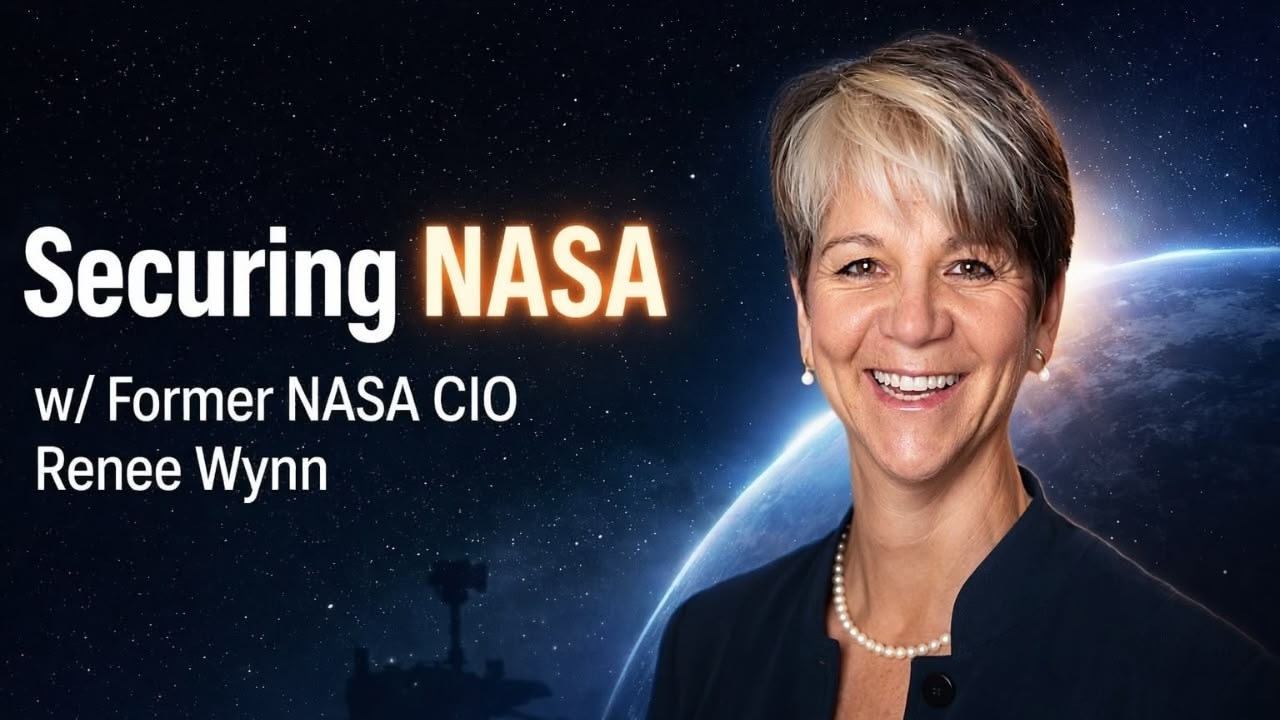
In this episode of the Security Cocktail Hour, we sit down with Renee Wynn, former CIO of NASA, to explore what cybersecurity looks like when traditional frameworks simply don’t apply. Renee managed IT for some of humanity’s most critical infrastructure: Mars rovers, the James Webb Space Telescope, the International Space Station. We cover the unique challenges of cybersecurity in the aerospace, defense and space fields—and what those constraints teach us about security thinking more broadly.
What We Cover
- Why there’s no multi-factor authentication on Mars rovers
- How NASA builds redundancy into everything—“belt, suspenders, and duct tape”
- Protecting intellectual property and hypersonic technology from nation-state threats
- The real-world impact of space debris on the International Space Station
- How GPS, weather satellites, and space technology shape our daily lives
- AI on Mars since 2003 and the emerging threat of AI-driven cyberattacks
- The ethics of AI bias and the importance of questioning your data sources
- NASA’s OSIRIS-REx asteroid sample return mission
Listen Now
Tune in to hear our discussion with Renee Wynn.
Guest Bio
Renee Wynn is a strategic Independent Board Director, Former CIO, and C-level Officer with 30+ years of diverse governance experience, notably, at two esteemed federal agencies – the National Aeronautics and Space Administration (NASA) and the Environmental Protection Agency (EPA).
📝 Full Episode Transcript ▼
Renee P. Wynn (00:00) we always have to make sure we don’t have a failure of imagination when we’re looking at these risk based decisions.
You know, some people like, well, it’ll never get out. Well, yeah, well, there are a lot of things we’ve learned in our life that have taught us that a failure of imagination means national security or regular security is is definitely easy to compromise.
Joe Patti (00:51) Welcome to the Security Cocktail Hour. I’m Joe Patti
Adam (00:54) Madam Roth.
Joe Patti (00:56) Adam, I am really excited about today because we have a guest on who has the coolest resume on LinkedIn I’ve ever seen. As soon as I saw it, I said, we have to have Renee on. It says, you know, technology expert, all this stuff, all these things that, responsible for the IT of like the James Webb telescope and the Mars rovers. And I was like, ⁓ I can’t wait to meet Renee Winn. Hey Renee, welcome to the show.
Renee P. Wynn (01:15) and that’s what it is.
Thank you, Joe, Adam. It’s great to be here and it’s great to talk. We can talk about space. can talk about cybersecurity. We can talk about IT, but it’s cocktail hour too, so we can also make it really fun for your listeners.
Adam (01:35) Great. I have one question to start off. How do you send somebody from Helpdesk to take care of the Mars Rover?
Renee P. Wynn (01:42) So first, let’s just begin. There is no multi-factor authentication on any rover that exists on Mars, right? Because it’s kind of hard to get the robot to take its card out and put it in and then remember to take it out at the end of the night. Actually, it’s funny. We begin with that story. It’s one of my first meetings at the Office of Management and Budget.
Adam (01:48) I’m so sorry.
Renee P. Wynn (02:11) when I became the CIO of NASA was about NASA’s slow ⁓ process of bringing in multi-factor authentication, the use of our cards, PIV cards, know, with CAT keys, there’s all sorts of nicknames for them. And I was getting pummeled a bit and they’re going on and on and on. And I was answering their questions and after a while,
I personally can only sort of take so much of the same question. Now, if I was a congressional hearing, I would take it the whole time through, but this was the Office of Management and Budget. And I looked at them and I said, you have my personal assurances that NASA will improve its percentage.
Joe Patti (02:41) ⁓ you
Renee P. Wynn (02:54) of applications in computers that use these PIV cards. However, there’ll be a few missing because it is not the PIV card is not safety tested for flight on the International Space Station. So we won’t be doing it there. I was just so mad I burst out about PIV cards being unsafe on the International Space Station. And the good news is that was the end of that conversation.
Adam (03:18) Because it was like, it was a mic drop, basically. It a mic drop and they were speechless.
Renee P. Wynn (03:23) Well, I think they understood that they had just gone, I think that they had gone too far. And I know these folks, right? You have to a couple of questions and you answer them. We don’t really need to keep going around the bush 18 more times. And so ⁓ that was the end of that conversation. And actually, it was pretty funny is from there we were able to pivot, I think a really good trust.
relationship right in DC and actually any place that you work, you do have to have a high trust and it takes a long time to build those relationships. Doesn’t take long to take them down a notch or two. So I think it was the start of a much better relationship with the office of management and budget under that. At that at that time. So every once in a while I would pull out my space card or tell space stories to get them to back off for a little while and they were entertained. So that worked.
Joe Patti (04:16) Well, I’ve got some pretty good auditor stories, but I’ll tell you, I can’t top that one. That one’s good. ⁓
Renee P. Wynn (04:22) But do you guys that ever happened to you, you’re just being asked the same question different ways, but it’s the same one and you’re just, I’m done with you guys, right? And I just said, you can expect our numbers to go up, but it’ll never be a hundred percent.
Adam (04:35) yeah.
Joe Patti (04:35) I’ve had
the auditors say like, ⁓ you’re at like 97 % for this, what are going to do about the other three? And I go, you’re going to issue me a finding, you should be giving me a medal for this in certain areas, you know, are you kidding me?
Renee P. Wynn (04:46) I know.
Adam (04:49) Well,
I got upset by a line of questioning when I used to work for Joe and I ended up in HR, but that’s another story. And that had nothing to do with Joe. It was a line of questioning about something that I felt these people should have really understood about security. And I don’t, I don’t want to kind of allude to where it was. And Joe’s like, you just take it slow. ⁓ Joe, I just got a call from HR. I didn’t want to talk to me. And Joe’s like, ⁓ okay. You remember that Joe, huh?
Joe Patti (05:19) I remember I’m like, please don’t bring me into this. Please don’t bring me into this. That’s all I can think of. ⁓ I’m like, what did you do?
Renee P. Wynn (05:22) i know, you’re on your own bud, you’re on
Adam (05:22) Because I was so tired of the line of I I
Renee P. Wynn (05:27) your own
Adam (05:28) got I got tired of the line of questioning but let me ask you a question Renee like we talked about OMB we talked about MFA Didn’t somebody lose a certain amount of people’s credentials at OMB? What happened there with MFA?
Renee P. Wynn (05:44) Yeah, then you know, that’s the thing, right? It’s you’re never doing this is, you know, cybersecurity, security cocktail hour, right? Nothing is ever 100%. cybersecurity is about making risk based decisions based on
Adam (05:55) No, never.
Renee P. Wynn (06:02) I guess the value of the data either on the market or to the business itself. So if you say on the market, medical records, right? Getting those on the dark web, you pay a certain cost and you can get that information. But there’s some information that goes out that means more to a business than it does out in the
on the dark web or out for sale or something like that. And that’s what’s really hard to talk to people about is breaking out the data that are valuable and that you have to protect like a Fort Knox. that which is, yeah, we don’t need to spend that much money protecting that data because it’s not PII, it’s not health data, right? It’s got business value, but is it a business secret? And it’s hard to get people to have those conversations because
they say, well, if it’s my data, it’s really, really important. And you’re never going to be 100%. So you always just go back to your risk matrix of what’s the worst that could happen. we always have to make sure we don’t have a failure of imagination when we’re looking at these risk based decisions.
You know, some people like, well, it’ll never get out. Well, yeah, well, there are a lot of things we’ve learned in our life that have taught us that a failure of imagination means national security or regular security is is definitely easy to compromise.
But yeah, so no one is perfect and one does have to be careful. But yeah.
Adam (07:31) Yeah,
disclosure you and I we met at ⁓ at capital text great con and One of the things I kind of like said to you when we were walking in the hallway Which I think is true about NASA right eight is four four is two two is one one is zero and Is that kind of correct about NASA? They always build in redundancy and with redundancy also comes multiple layers of security and anything else and that’s why I’m always so impressed
with NASA, but on the flip side, I also realize it’s risk versus reward. There are certain things you can’t implement. If you don’t have the budget and no one’s providing you that money, then you can’t implement certain things. You can ask for that money. Oh, we need X amount of dollars to do this. Well, you get in half. Well, then you got to restructure your security. You got to restructure your redundancy. I mean, I don’t know if that’s true, but it sounds like it.
Renee P. Wynn (08:24) Yeah, it is absolutely true. I used to always joke around at NASA, was belt suspenders and we’ll throw some duct tape in there too, just in case. And there’s good reasons for doing those types of redundancies, Rick, because in ⁓ a high test environment or a high stakes environment, let’s just put humans on a rocket and we’re sending it into space. And unfortunately, in the history of human space exploration, we have lost lives. And it was failures.
Adam (08:49) Yes.
Renee P. Wynn (08:53) as well as well. And some of those failures were human listening and actually hearing it, not just the messenger in the way you state your problem, but those listening, kind of hearing what somebody is trying to say and maybe being curious about what they’re trying to say, because maybe there’s a nugget in it that’s pretty important. So you build in these redundancies. And we’re always grateful for those. And then when it comes to budget cuts, it’s always
I find it both a it’s it’s a practice that you go through and I don’t know how many times I’ve been through it as 30 years in the United States federal government. Believe me, we could we could cut pennies in half if we needed to to get something done. It is about whether what’s your priority, but it’s also an opportunity to be creative. Right prioritization is if you’re going to do something big. So I managed a global
network including operations in Russia and United States and Roscosmos. So NASA and Roscosmos has excellent relationship. We shared seats on the Soyuz. That’s how we got for many years. It’s the only way we got our astronauts, United States astronauts into space up to the International Space Station.
And, but it is a contested environment
Joe Patti (10:10) you
Renee P. Wynn (10:12) to work in. And actually any network is a contested environment. We’re never a hundred percent safe. You’re, know, you’re never at zero risk or anything like that. Well, when we were operating there, we weren’t going to go on the cheap. would make sure that the data with the network and the data were well protected. But some of the other stuff that we did didn’t need all those protections. And we could be more creative on how we protected it in terms of processes.
locks we all love locks
Those always do a lot of good things too. And I wasn’t even allowed into the data centers without an escort. So even then just making just a certain number of people have access to things is another way to manage your security without bringing in all this fancy stuff. it’s risk versus reward. What are you trying to get to? Plus, can you be creative? Sometimes the lack of resources create even better solutions than the one that you would have gotten if you could have paid full fare.
Joe Patti (10:44) Mm-hmm.
Yeah, that’s interesting. It’s funny how that still comes down to risk management and priorities, like with everything. But what I’ve always found interesting is, like we did a show a while ago, and I used to work in the financial world and like high frequency trading and trading, the risks were very different. You had much higher impact. So things are skewed. It’s not what most people encounter. I think you had a lot of that.
Renee P. Wynn (11:17) Mm-hmm. Yeah.
Mm-hmm.
Thanks.
Joe Patti (11:37) Two, ⁓ a lot of things with lives at stake, a lot of things dealing with things that are, I mean, I would assume essentially unrecoverable, unfixable if you have a serious problem with them, and very expensive.
Renee P. Wynn (11:49) Yeah,
and you had, Joe, you’re mentioning at NASA in a lot of scientific places and in fact,
content that’s the written word. There’s a lot of intellectual property embedded in all of the data floating around and NASA was highly targeted. We’re building hypersonics. We just had an awesome test a few weeks ago, yay team. So who doesn’t want that? If we’ve spent the United States has spent multi-millions to develop a technology, who doesn’t want to get it for free and jumpstart?
Joe Patti (12:08) yeah.
Renee P. Wynn (12:23) their business or their countries space flight work. When I traveled under with my NASA badge and got to see a lot of other space programs, there is a lot of sharing in space programs in the science world, the technology world, and it’s a great thing. But there were also some
Adam (12:23) you
Renee P. Wynn (12:43) places that we weren’t necessarily sharing with. And I would look at some of their space artifacts and I go, hmm, I think I’ve seen that design somewhere before.
So the other side of the risk management isn’t just on the in it is in a way financial stuff, but it’s the intellectual property that could get stolen. People’s lives work and all of sudden somebody snags it and they get it to market faster. That’s the other thing that you’re protecting. And I don’t think a lot of people realize that protecting in the cyber world, the ether world that we can’t see, right? It’s not like when we get robbed from data or robbed at gunpoint, they just
Adam (13:15) Thank
Renee P. Wynn (13:25) come in, take it, and next thing you know, you’ve got all sorts of problems with that. And on the financial side, time, the splitting of a nanosecond and taking a penny, right? This is a real thing, taking a penny, get somebody really wealthy, and it takes a really long time to find that fraud and theft.
Joe Patti (13:35) Yes.
Renee P. Wynn (13:45) in the books because you were dealing with millions and billions and yes there were rounding errors and you kept going but then all of sudden we all noticed this nanosecond of one penny going into somebody else’s coffers and now they’re wealthy on some island until somebody figures it out so time intellectual property data are all the things that are at risk over the over the internet but also some great things happen over the internet too cat videos come on
Adam (14:13) love cat videos, I do have actually at capital tech. It was a conversation about, you know how the American astronauts and the Russian astronauts at the end of the day realized that they had the same life goals and family. But then when you think about it, we’re sharing information with adversaries and sometimes security is embedded in that, in that cohabitation, like in the ISS and the international space station.
It must be, I mean, again, I’m not asking for secrets or anything at all, but it must be really interesting to think about how you can share certain information safely without giving away the secrets. That must be an interesting thing.
Joe Patti (14:49) Thank
Renee P. Wynn (14:56) yeah, it is. ⁓ anybody who has clearances, right? So those of us that worked in cybersecurity world, actually in many of my I’ve had a clearance for a really long time and I needed it for a lot of different aspects of understanding what was going on with national security. But in cybersecurity, you’re really looking at a lot of.
nefarious activities and their techniques that was being used and who was using it and you’re at learning how to look at supply chain risk because people will invest in companies that the United States government is using in order to try to break into the United States government to get what’s going on in the United States government. But to your point, you don’t always have to know that
attribution of things. You just need to be able to tell stories to people to kind of go after their heartstrings to sort of compel behaviors that are more protective. And I think that goes farther than a whole bunch of people having clearances because sometimes you go, hmm, I wish I didn’t know that. But you can convert what you do know into stories to work with people that don’t have the clearances because they are your partner in trying to create
a better environment.
Joe Patti (16:14) at first I was thinking that, yes, on the ISS you have all these people that they’re from different nations. Some of them are different levels of friendliness these days. ⁓ And they’re surrounded by their nation’s highest technology, their best stuff. But I would think that that pales compared to what you have on the ground amongst hundreds, thousands of people working.
Renee P. Wynn (16:25) Thanks.
Thank
Joe Patti (16:41) working
together, trying to get all this stuff going, right?
Renee P. Wynn (16:45) Yes, it was. So one of the things, so I was new to NASA. Most of the folks that are at NASA have been there for years and they love NASA and they love the mission. It’s why for so long it held the best places to work in the United States federal government for so long. And it didn’t take long when I was there to realize that. I was like, oh my gosh, I get why NASA wins this.
a lot. And part of it is everyone at NASA is part of something bigger than themselves. You’ve got the aeronautics missions and looking at hypersonics. NASA did a big research project years ago on urban flying, urban traffic management with
Joe Patti (17:37) you
Renee P. Wynn (17:39) the UASs with all of the drones that are going to potentially be in cities to deliver pizza. Well, how does the drone delivering a pizza get out of the way of the drone delivering an organ to a hospital? And by the way, an organ has been delivered by drone for an organ transplant. So you and I, we get out of the way.
Joe Patti (17:40) Mm.
Hello.
Renee P. Wynn (18:02) because we hear a siren. So NASA studied with a lot of other partners on how to do this. And so now we’ve got all of these folks working on.
drone issues and challenges and opportunities with them. And so we’ve got aeronautics and now we’ve gone to the drones and uncrewed flight. We like to say uncrewed because if I’m flying it, it’s still unmanned. ⁓ But then we can move over to space and space exploration. But what about the science in space as well? NASA did a big thing with calling anybody that wanted to participate across the globe of identifying
exoplanets and exoplanets are those planets a lot like Earth. And so the data was put out publicly and so people could participate in finding scientifically defensible suggestions, right? So they’re like, okay, here’s what I found and here’s why you should consider an exoplanet. And so we have these big contests and ways to bring people in and make them part of space. So just the space
Joe Patti (18:45) Mm-hmm.
Renee P. Wynn (19:13) science beyond people, beyond flying is still pretty phenomenal. finding, you we’re looking at Mars with the water, you know, evidence of water being there and what does that mean to type of life that could be on Mars and that, and so, yeah, so there isn’t anybody that isn’t really invested in trying to make science fiction turn into fact every single day.
Joe Patti (19:14) you
it is amazing because I was into all that kind of stuff when I was a kid. I grew up in the Apollo era and all of that. But when I thought it was cool, I’d see all these things. I had a stack of national geographics that I saved that were all the space issues. But you look at the things now, like you’re talking about the exoplanets, the things going on on Mars. I just saw something last night.
about the Voyager probes, what they’re finding And I’m like, you know, it’s not that long. I like to think it’s not that long since I was a kid, but we know so much more than we did then. It really is astounding, even for a lay person, to see how far we’ve come. It’s very cool.
Renee P. Wynn (20:12) Yeah.
Yeah,
I think it’s exciting to Joe when you share that what you do is that was the thing is, is being from NASA, a of people share about a lifetime.
following of NASA, but I would always learn something because they were following something of NASA that might never come up at an agency meeting that I was attending. And so I would learn a lot just traveling and talking to people about their love of NASA or their love of space and what they liked about it. I was like, I didn’t know we did that. look at, you know, we’ve had a first incident of solar storms now becoming a real risk. It’s always been tracked.
is a risk when you have a satellite, but now we’re seeing with greater solar storms, to make for better northern lights, which is always a lovely benefit, but it’s creating more problems, more frequent problems with our communication systems, our communication satellites, and in fact now satellites have to be, you need to be a lot more cognizant of your satellites and potential solar storms having an impact on them more so than we used to. And is it because
Is the use to now because we have more information or that we have more satellites that have had impacts from solar flares, right? It’s that whole thing when we say, there’s more people with an XYZ disease. You always have to ask yourself, is it because we can now test for it? And so that creates this ⁓ diagnosis, more ⁓ greater number of diagnoses of something. Or is it really an actual greater increase in
this particular disease based on actual true numbers and it’s something you kind of think you have to ask yourself about some of the things going on in space. We just know more, but we don’t know at all.
Joe Patti (21:56) you
Adam (22:05) Yeah,
I think it’s amazing. Even some of my colleagues at Capital Tech, they’re studying space garbage, how important it is to understand where that garbage goes and whether or not it can affect satellites, communications, and what happens to it. And people like garbage, who cares? It’s a big thing. And then what I also find amazing is whether it’s signals or lights or things that we’re getting to Earth, what do they mean? Is it because of the planet? Is it because the
Joe Patti (22:26) you
Adam (22:35) the beginning of the universe, people are trying to understand what these signals are. And then we also talk about space, but we don’t also realize, a lot of us, that space controls a lot of our earthly technology, whether it’s, you said, GPS, whether it’s being able to know where weather is about crops and things of that nature, water, precipitation. And then I think most importantly, we all talk about like nuclear weapons and, you my God, how bad they are, but
Joe Patti (22:49) Hmm?
Adam (23:04) What if we had to use them hopefully to defend our planet against asteroids or other things? I know the size of these things are amazing, but we’ve been very lucky that we have not been hit at the level that we’ve been hit. So what’s going to happen in 10 years, 15 years? Will we be able to stop some kind of projectile that’s heading towards Earth?
Renee P. Wynn (23:26) Yeah, so Adam, you’re absolutely right. Our daily lives touch space pretty well all the time. Right now, I don’t know about you guys, but I got a lot of packages coming into my house. Those packages are getting from wherever they are point of origination to me through the GPS system. Right? How do they find my house? And I can tell you, for a long time, my house was harder to find, but now we’ve refined.
Joe Patti (23:45) Right.
Renee P. Wynn (23:52) Probably mostly thanks to Google driving around, finding everybody’s places of where they lived, where things were, and then mapping all of that. And so now we get deliveries to the house. That same technology is used for, let’s say, dating apps as well. Find love in my city. Well, how do you know they’re in my city? Well, because embedded behind them is a GPS-like system. Our weather and our weather is a strategic asset.
If I’m, if I was to do a military operations, I’m going to have to be looking at the weather of what, what I’m trying to do, how weather could impact what I was trying to do, my mission objectives, and then do scenario builds on, on how much it would take us off mission or not take us off mission. But weather becomes part of that strategic study on your tactics and that, and, you know, we also need to know whether, so we know what to wear for the day.
and that you don’t want to get caught. But then our weather and our climate models, they help us get out of harm’s way. Tragic tsunamis are happening, typhoons are happening, hurricanes, same difference, just depends upon where you live.
Adam (24:58) Yes.
Joe Patti (24:59) Mm-hmm.
Renee P. Wynn (25:04) Well, one of the things was fascinating looking at some of the research that NASA was doing collectively with a lot of other partners. And if we could shrink the path of prediction for a hurricane, then the people that used to be in the bands, let’s say a band was this big for your hurricane, everybody would prepare, right? The hundreds of miles long band in this. Well, as we’ve gotten better, this band shrinks. So these people don’t have to stop what they’re doing.
to prepare for a hurricane that might hit. They can go about their merry business and maybe they’ll help with the hurricane or maybe they won’t even have to worry about it. They get to make their own choices. So that’s what’s fascinating about Weather Data is by refining our models and getting better with that and technology improving, we now don’t disrupt lives and that’s a great thing and to do that. So there’s all sorts of things that become part of our daily life.
Just getting us through traffic is probably the favorite one because I live in one of the worst traffic areas in the world recently declared and I am always grateful for understanding the back roads. Yeah.
Joe Patti (26:16) Well, I find it interesting, something that’s not talked a lot about by techies like me and Adam, at least, is how the GPS and the weather predictions and all are being used in agriculture. We kind of take it for granted that the supermarket shelves are going to be full pretty much all the time in this country. apparently, that’s how they produce it. And that’s how they produce it cheap. There’s a tremendous amount of data they can get. And knowing the weather and all that, it’s amazing.
Renee P. Wynn (26:27) Hmm?
Yes.
Yeah, will you?
Right. So they we have a whole set of satellites that do soil moisture. Right. Right. Yeah. And you’re kind of like, I know when I got there, not not having been a farmer, I I appreciate all that farmers do, you know, is I like to eat and
Joe Patti (26:50) really? Okay.
Renee P. Wynn (27:02) you I was like soil moisture and so you dig into it more and you go ⁓ well that makes sense right because certain crops won’t grow if it’s too moist and you know one way or another and food security is an issue in this country and you know so the more we know the better I guess the more we know the better we can grow I guess that’s what you can say.
Adam (27:23) ⁓ it’s a good tagline
for the podcast. you know, it’s funny, like this all comes together, right? When you talk about food security, you talk about drones, you talk about GPS, you talk about priority, everything. So drone, became a UAV pilot because I’m so interested in drones. like, I own like two drones. I borrowed another drone. It’s amazing. But, you know,
Joe Patti (27:50) Yeah,
Adam always sends me videos of like his neighborhood from his drone. And I go, what is this? Why are you sending me this? know what your neighborhood looks like.
Adam (27:58) So I just I’m just amazed because
with drones comes comes GPS with drones comes the ability to download video technology from you know Wi-Fi and advanced other technologies with drones comes the ability to deliver ⁓ Items and it’s funny when you think about drones Which drone has priority it might have to do with literally? You know in in general in general ⁓
Voting, you know, depending on which way you’re coming is who has a priority. But maybe these drones can send signals to each other that says, have the priority. I’m an emergency vehicle. You know, here’s my lights. Whoa, whoa, whoa, whoa, type of thing. it’s really it’s insane how much space that we depend on, because if we don’t have GPS, drones are going to be crashing into everything. So it’s interesting.
Joe Patti (28:51) you
Renee P. Wynn (28:52) Yeah, yeah, and GPS is hackable. Which is equally. No, no, no, don’t.
Joe Patti (28:56) Yeah.
Adam (28:56) I’ve done that. I, I, when I, when I used to, no,
Joe Patti (28:58) Ow.
You’ve tried.
Adam (29:00) no, when I had, when I had Facebook, I had this app and I would turn around and put myself in like in North Korea or in Afghanistan and people like, what are you doing there? I’m like, it’s just a freaking GPS fake app, which anybody can really download, but not, no, it was back. Yeah. Well, they, the, um, no one’s come to my house in the last 10 years about my Facebook posts that I did 10 years ago. So I think I’m in the clear.
Joe Patti (29:13) get yourself in trouble. ⁓
Renee P. Wynn (29:14) I don’t
he is.
Adam (29:25) But people are like, what are you doing in North Korea? I’m I’m visiting my friends.
Renee P. Wynn (29:25) That’s good.
because Adam had mentioned debris and we didn’t touch about that space debris is a big issue. And there’s a lot of research going on in that area and grateful for that. But let’s talk about what does that mean to any individual?
Joe Patti (29:34) Mm-hmm.
Renee P. Wynn (29:42) First and before I get into that, I want to talk about what it means to astronauts. First of all, I want to remind your listeners, we’ve had humans living in space for over 25 years. Every day, every single day. So space debris is a big deal. On a regular basis, International Space Station takes evasive measures because as I call it, the polygon of safety around the International Space Station
Things get predicted, debris gets predicted to potentially enter into that polygon of safety, at which point then a maneuver needs to be made in order to avoid hitting, getting hit. Well, okay, you say, why is getting hit by a small item a big deal? Well, first of all, the item is probably ⁓ traveling at 17,000 miles per hour. So now people can do the math.
And the second thing is, is actually a pebble size piece of debris hit the arm on the International Space Station. And now you have to question the effectiveness of that arm in a mission outside of, you know, the use of that arm in a mission.
So the astronauts had to go inspect the arm. you had a extravehicular activity. That’s what they call it, an EVA. I’m like, it’s a moonwalk, right? Well, it’s not really a moonwalk. It’s a spacewalk. And they would go out. Well, before they can go out, they got to make sure there’s no debris kind of coming and putting humans in arms way. We’ve seen all of these movies.
Joe Patti (31:06) Right.
Renee P. Wynn (31:17) They’re pretty fantastic to watch, but they’re just heart wrenching also to watch. So they go out, they inspect, then they, you know, engineering determination is made whether that arm can still function as it’s supposed to, like exactly like it’s supposed to so that there isn’t a safety issue. So debris means something to International Space Station because humans are up there, but that same debris can hit satellites and it can take the satellite out. It can impact its capabilities that we might be relying on.
And space debris is growing. are now more nations or there are more businesses, not nations, there are more businesses, commercial practices that have satellites in space than nations themselves. And so it’s also changing the dynamics of space. And I personally believe if you’re operating in space, you need to understand the national security implications of what you’re doing in space and be cognizant of that and operate your business accordingly.
Don’t be surprised if someone says, your satellite is a problem. Because if you’re going in space, you need to understand that it’s vast, but it’s not so vast that we don’t have so much going on in low Earth orbit that we don’t run into each other. And that’s a big problem as well. And debris is a big piece. A lot of research is going on, excited about what the future can hold in terms of how to manage space debris better. But in the meantime, I think folks need to understand it’s
Adam (32:22) Thank
Renee P. Wynn (32:46) Space is highly contested.
Adam (32:48) What I I found amazing was that and I don’t even know the number I know was a ridiculous amount of number of satellites in space people like an unfathomable amount of number but ⁓ What I found amazing was you know during one of the conversations one of the one of the presentations that we had a capital attack that a satellite it’s able to move into a position to block two of the satellites and communicating and That’s just insane that you could like it’s like let me drive my car a little bit between these two cars so they can’t move
It’s almost like the same thing. It’s just, it’s insane. like just like put out a little bit of air and you move it into place. Boom, you’re done. Right? That sounds, it sounds stupid, but it’s true. Right? So.
Renee P. Wynn (33:31) Yep, yep,
Joe Patti (33:32) Yeah.
Renee P. Wynn (33:33) that one’s pretty cool.
Joe Patti (33:34) Well, I’ll tell you something amazing when you talk about space debris. I will admit, guess, being a geek And I know we weren’t going to talk about aliens. We’re not going to talk about aliens. But do remember that old show, UFO, from the 70s that was very cheesy and awful? They had a moon base, and they were fighting the aliens. The guys spray painted green.
Renee P. Wynn (33:52) Thank you.
Joe Patti (33:57) They did an episode where actually the guy who was in charge was complaining about space debris and said, we have to do something about this because my astronauts are in danger. Of course, it was all fictional. But I had no idea that this was an issue. mean, going back, I think it was made in like 1970 or something. And today, I heard it’s just a junkyard.
Renee P. Wynn (34:04) So, thank you for listening.
Yeah,
yeah, it is a new diagram since we’re getting ready to close a year here soon. I would imagine by spring we’ll start to see new illustrations of the amount of debris in close in to earth and that’ll just, new numbers and new.
and a new picture that goes along with that, that, you know, the picture I think does a lot for really understanding what’s just above us by a couple hundred miles. Yeah. And Joe, to your point, science fiction is, I think, hugely important to space. And I think it’s also hugely important to cybersecurity. When you can help people.
wrap their imagination around something, then in the future when that something becomes true, like space debris, people will go, yeah, I remember this episode, right? And it was predicted, predicted for drama, but now it’s been predicted. Now it doesn’t seem so foreign.
Adam (35:16) Cough
Joe Patti (35:16) Mm-hmm.
Renee P. Wynn (35:26) New concepts, a lot of people are very skeptical of, but if you’ve heard them a few times, such as in science fiction, now all of a sudden you’re like, yeah, I do remember this. And now it’s much easier to get people to collaborate on solving problems when you don’t have to overcome their reticence or their, you know, I don’t believe it at all. Now people should be skeptical and look at the data and everything, but science fiction has a role in, I think, the world of space exploration.
the world of airspace, the drones, and I think it also has a huge place in cybersecurity.
Joe Patti (36:03) Yeah, it’s clearly inspired a lot of people, including in AI. OK, this is the mandatory AI part of the episode. We have to always talk about that. And today we have AI in space, which is even better.
Renee P. Wynn (36:09) Oops.
You know we do so just to get the listeners rate so we’ve had rovers on Mars We the United States NASA have been with them for a while, but still feel like I’m part of them and That is since 2003 so AI has been on Mars since 2003 and sometimes when I make speeches is like well finally got to earth for us to use and really what AI is now is is much more ⁓ part of
much more of our daily lives. Back to talking about space, I know I use it, but a lot of things that are going on with our computers and everything, we’ve seen the first AI driven cybersecurity attack wasn’t necessarily more lethal, but it was much more, it was just a lot more things thrown, much more threats thrown at the objects of interest. And partially they’re trying to see what things are coming through. And so AI is now becoming part of our
Joe Patti (36:59) Yeah.
Yes.
Renee P. Wynn (37:16) lives and you know it needs guardrails absolutely needs guardrails.
Adam (37:21) in the scope of science fiction Everything is impossible until it’s possible, you know regular flight right brothers was never gonna work going to the moon impossible and Recently somebody actually played a joke on me and said we’re I know somebody who’s working on a tractor beam I said, okay
Renee P. Wynn (37:26) Hmm
Adam (37:41) And then I started doing research. I started doing research. I’m like, it’s not impossible. There is the minute ability to do stuff with energy. But the person said, no, I was just joking with you. I said, well, I looked it up and it is possible because same reason why we have done what they claim to be, you know, travel and time. like, like, I don’t know what it is, a super like whatever microsecond or something like whatever it is. I mean, it sounds so minute, like whatever. But what I’m getting at is.
we joke around today and people can make fun of people. But what we’ve seen in movies in the past has become a reality. Maybe for dramatization in the movies and TV shows, but it seems that somehow or another we manifest our science fiction into fiction.
Renee P. Wynn (38:26) do.
Joe Patti (38:27) Yeah, and it’s interesting to see. I’ve always been very interested in technology, and especially in cybersecurity, of these things that we talk about. We predicted the technology. We predicted something. What happens when it really hits? How is it used? we’ve seen so many things. I remember going back years and years and years, we were talking about certain types of malware. We’re like, oh, they’ll never get it to run on us.
Renee P. Wynn (38:43) Mm-hmm.
Joe Patti (38:54) point of sale system or they’ll never be able to do this remotely, it’s too hard. And they’ve been able to do everything and the impact of all of that is profound. that’s actually what I worry about with the AI stuff because, Renee, first AI attack you were talking about, we’ve been waiting for it. We knew it was coming, but we still don’t know what’s going to happen with it.
Renee P. Wynn (39:13) Yeah, yeah.
Well, that’s exactly right. And you can convert AI.
into helping you build scenarios and tabletops that push the imagination so that you can practice on the obscure, you know, and you can make it an inject into a tabletop, right? You’d be doing your typical tabletop, but you could do a really odd inject and you could help develop that using AI as long as, mean, one of the things about rate is AI is you get in a little bit, if you’re using it for decision-making,
Some of the biases that you put in, you might not realize those biases, will bias some of the answers out. So you’ve got to learn how to do the prompts that take away your personal biases you put in. And can you imagine the scenarios that you could come up with using AI and then use that on an inject? being prepared is that it’s understanding that what’s possible and then preparing for what’s possible.
Adam (40:03) Yeah.
Renee P. Wynn (40:22) and making sure that you’ve got the best protections in place or the best course of action in place to go after or to respond to an incident of sorts, whether it’s cybersecurity or physical security one.
Joe Patti (40:33) you
Adam (40:39) we’re touching on a very passionate subject of mine about ethics and,
Depending on how you do your LLM, your language, ⁓ you can inject information into an LLM, but put the wrong information unbiased. And what I mean by that is, what is your sample?
So this actually has come up before with medical information. And you would ask a certain LLM, certain AI bot, tell me about the amount of people that might have a certain disease. But the people that were introduced into this LLM might’ve been just a sampling of white people, 40 to 60 years old, whereas,
the other race was not used and that gave the wrong information back. you can be, you can not, you don’t have to be biased to be considered to be unethical because you used the wrong sample and you got to be very conscious of that. And it’s funny because anybody who’s going for a doctorate has to take a class on ethics to know who you’re sampling and what you’re doing in order to provide the most possible ⁓ deliverable
research that you can, it’s unconscious bias.
Renee P. Wynn (42:05) Yeah,
Well, that’s good to question. And I think for everybody who studied philosophy and ethics in those liberal arts schools, which I am a graduate of liberal arts school, there is a new job opportunities for them.
And this is not a job that AI could take. It’s working with ⁓ policy teams and technical teams and legal teams and that and really working on the boundaries of the AI for whether it’s the business itself or the use of it in a government at all levels of that government. It has a use. It has its place. It has its limitations. No technology is the panacea. But it has the opportunity to make humans better. But you really do have to look at the ethics
of it and what is it that you’re trying to solve for. So it is kind of complex to use if you’re using it for more complex things besides could you give me a gift list for a 88 year old man? Thank you, appreciate it.
Adam (43:03) And I guess you’ve really touched upon it, right? I know this is a little bit morbid, but there are people who are lonely and they have conversations with ChatGPT and other things. And unfortunately, in the past, these AIs have returned wrongful information that have caused people to do harm. At the same time, people have used AI to research their disease and might’ve been given the wrong information.
So you gotta be very conscious of what you’re doing. Like every time I get blood test results, the first thing I’m, the last thing I’m doing is researching what they are because I might not understand the reason why. And that’s actually something recently that just came up. You know, I thought I saw something a little bit irregular and like, no, no, that’s regular for this and that. So you gotta be really careful if you don’t know the context of what you’re asking. You might be asking the wrong questions. Why does this look like this?
Renee P. Wynn (43:52) Hmm? Hmm?
Adam (43:59) But you didn’t add, why does this look like this? Because I’m taking this medication. So you can get influence and go down a rabbit hole using AI. So you gotta be very careful.
Renee P. Wynn (44:11) I ask for sources. I asked for a source one time probably a year and a half ago when I was playing with it and it was like, I made it up. I just laughed out loud and I’m like, well, thanks for your honesty.
Joe Patti (44:24) ⁓ yeah. I find it hilarious when it gives you something. And it’s amazing that this trick still works on a lot of them. And you say, are you sure about that? Is that right? And then it goes to the things that it says, yeah, I got that totally wrong. Sorry. OK.
Adam (44:25) you
Renee P. Wynn (44:38) Yes, right. But you know what? Humans
don’t always do that, right? So having run a large organization, you look at them, you go, I don’t understand that. Are you sure? And you get, you get this. I’m absolutely sure.
that voice, the body language, and the conviction to that one. And you know, you find out later that wasn’t so certain either. So at least it’s when you question it, you can get the, okay, I’m not so sure about it.
Adam (45:10) So Rene, I made a mistake once. I was doing research on my dissertation and I was looking for a book and I found the book and it returned. I said, give me a scholar resource and it gave it to me. So I couldn’t get to it. I it was behind a paywall. So I sent it over to Capital Tech to the library and I said, can you find this book for me? And they’re like, where did you get this information? It doesn’t exist. I’m like, my God, I’m so embarrassed. I said, I asked Chatchat P.T. to give it to me.
Joe Patti (45:31) Yeah.
Adam (45:38) And I said, give me a scholarly source and it made it up. And then they said, OK, no problem. Like I think they were saying like, I’m going to kick the living crap out of you when I see you type of thing. But but but the point I’m making is I even said, give me a scholarly source and I couldn’t get to it. So I think it was behind a paywall, but it didn’t even exist. They made it up.
Renee P. Wynn (45:54) Yeah.
Yep. Yep. Well, you know, lessons learned, they come cheap and they come expensive. The cheap ones are when someone says don’t do something and the expensive ones, someone says don’t do it and you do it anyway. But I don’t think the paywall one was right. You’re just going down. You’re just going down trying to find the citation, which was good research technique. It just didn’t really exist. It’s a black hole.
Adam (46:18) Well, thank God I didn’t quote
it. Yeah, thank God I didn’t quote it. Like, because I was always afraid when I send something to somebody, especially my dissertation professor, which you know who it is, I’m afraid he’s going to just drive up to New York and beat the crap out of me because like, Adam, what are you doing? Come on. Because I’m a Marine. What are you doing? You know, that’s what I’m always afraid of. I don’t want to give the wrong information.
Joe Patti (46:42) It’s good to be wary, know, they’re tools and, you know, it’s not what we’re used to in a lot of cases, the way they work, you know. ⁓ We’re used to people like you were saying, Rene. We know someone who’s completely certain maybe is wrong, maybe is putting on a show because they’re embarrassed. We know that psychology to a certain extent and we still get tricked by it. But, you know, that’s something we expect from people, from machines and from, you know, information systems.
Renee P. Wynn (46:47) Right.
Joe Patti (47:11) We expect them to be accurate. expect them to give us the right answer or nothing, or just blow up and not work. You know, the whole thing of it giving you the wrong answer or a biased answer is something I think we’re just not used to yet. And we’re going to have to get accustomed to it.
Renee P. Wynn (47:17) Steps.
Yeah.
Right.
Adam (47:31) I saw the weirdest thing. saw it was this joke about, so we have an AI like LLM that’s actually, I forgot what country is like a commissioner or something right now. I forgot what country it was, but they made them a commissioner of something. And then I saw this weird cartoon about these AI LLMs, these AI bots going looking for DEI. Because now there’s so many of them. Now they’re like.
teaming up together like we want equity also.
Renee P. Wynn (48:02) Yes, I did read about that as well. ⁓ Experimentation is a good thing, but go in with your eyes wide open.
Adam (48:11) Yes, I think we’re wrapping up,
Renee P. Wynn (48:15) I so. Well, you know, before we wrap up, I do, have a favorite space story and part of it is a bit of the science fiction into fact. So when I was at NASA, Osiris-REx was launched and Osiris-REx was the mission objective was to land on an asteroid and land a robot on an asteroid, take a sample and have that sample returned to the United States. That’s been done, right?
Asteroids traveling 17,000 miles an hour, a satellite releases a robot, the robot goes down onto the surface, scoops up that sample. Now it has a little trouble closing the door, and then that sample returns back to the United States, and they had some troubles getting the whole thing open, but they did, and I’ve actually seen a sample of the Bennu at a university. I happened to be there, and I was looking, I was like, oh my gosh, and then…
Joe Patti (49:10) Wow.
Renee P. Wynn (49:13) the curator said, well, the professor actually works with NASA quite a bit. she and I walked through, she walked with me through the entire museum. It was a geological, I guess it was a museum, it geological facility and that we had a great conversation. So I’ve actually seen some of this. Well, they’re doing studies on this one. And so to me, it just…
there aren’t limitations to what humans can do, right? Is can you imagine thinking we’re gonna get a satellite, we’re gonna position it close enough to an asteroid, hold it, right? So now two bodies in motion, get a robot on it, take a sample, return that sample and we’re gonna study it. How’s that pitch going to Congress?
But somewhere along the way, people believed it was possible and there were things to be learned from it. And so that is going on right now. That science is coming out in various. I follow NASA headlines on Google and every once in a while a new OSIRIS-REx headline will come through. But I do want to give kudos to Japan. Japan was actually first and they have shared their sample with the United States. And so we’ve got a couple of them now of asteroids that didn’t burn up. You know, why is this so cool is because they didn’t
up in our atmosphere. They have come through our atmosphere and been protected. So the study of it is the first of its kind and it’s here in our lifetime and we’re learning a lot from it. We’re learning a lot about space and how things are formed in space and what does that mean for the formation of our great planet. ⁓
So I always love that story because it really demonstrates to people of what’s possible and they had to pitch it to get the money so other people also had to believe that it’s possible. And so just one of my favorite stories about one of the accomplishments that NASA and its partners achieved. ⁓
Adam (51:05) ability
to explore is only limited by our imagination.
Renee P. Wynn (51:08) Yeah, that’s right. That’s exactly right. Good. Well, yeah.
Joe Patti (51:14) Well, Rene, thank you so much for joining us. This has been a lot of fun. And we learned something. I said it’s always a good show when we learn something we didn’t know. Although this one’s kind of a layup, because I have so much to learn in these areas. It’s pretty easy. Of course, Adam knows everything about drones. we don’t have anything there.
Renee P. Wynn (51:20) Great.
⁓
Adam (51:34) ⁓
I know nothing about drones. I know enough to know I don’t know anything. know, recently I said something ⁓ to the Dean of the Graduate Studies at Capital Tech. said, you know, what I have learned is very similar to martial arts. When you become a white belt, you realize you don’t know anything. When you become a blue belt or green belt, you think you know everything. When you become a black belt,
you realize you really don’t know anything. And this is the beginning stages. And I’m on that mission. I’m on that trajectory to realize that I just found out I really don’t know anything. And I’m very hungry to learn more. And that actually was ignited by my drive to go for a doctorate. I realized I’ll never know what I think I would want to know.
And what’s also impressive is when we have these conversations with a about NASA. These are some of the most brilliant minds on the planet. It’s insane how brilliant some of these people are. I mean, like we talk about how brilliant they are, but you don’t know until and I don’t even know. I only spoke to one or two of them. ⁓ One of them is actually one of my colleagues. We spoke about that, but don’t realize how brilliant in the thought process somebody has and to have actually been in their presence.
It’s amazing.
Renee P. Wynn (53:01) Yep, but Adam, I have one correction and that is not all the brilliant people of NASA are on this planet. Some of them live in International Space Station, so just one minor correction.
Adam (53:10) I thought you were gonna talk about
the aliens.
Joe Patti (53:12) What?
Adam (53:13) Yeah, I know. But hey, you know what? I’ll put you on the spot. Maybe you can help us get an astronaut on the show.
Joe Patti (53:15) Well…
Renee P. Wynn (53:19) Be able to. We’ll see.
Joe Patti (53:22) Yeah, we have a wish list. It includes an astronaut and it includes the ancient aliens guy. We got to get him somehow. ⁓
Adam (53:29) Hehehehehe
Renee P. Wynn (53:29) You do? You guys should.
That would be great. Super. Well, it’s been a treat. Thank you.
Joe Patti (53:34) All right.
Yes, Riddase, thank you so much for joining us. We’ve had a lot of fun. All right. And thanks everyone for listening.
Adam (53:36) Thank you.
Thank you.